

Why Is Everyone Running?
Why do people in Korea often seem to be hurrying—even when there is apparently nowhere urgent to go? Starting with one woman’s determined twenty-metre dash in 34°C heat, this light-hearted story explores ppalli ppalli culture,
It happened again today.......
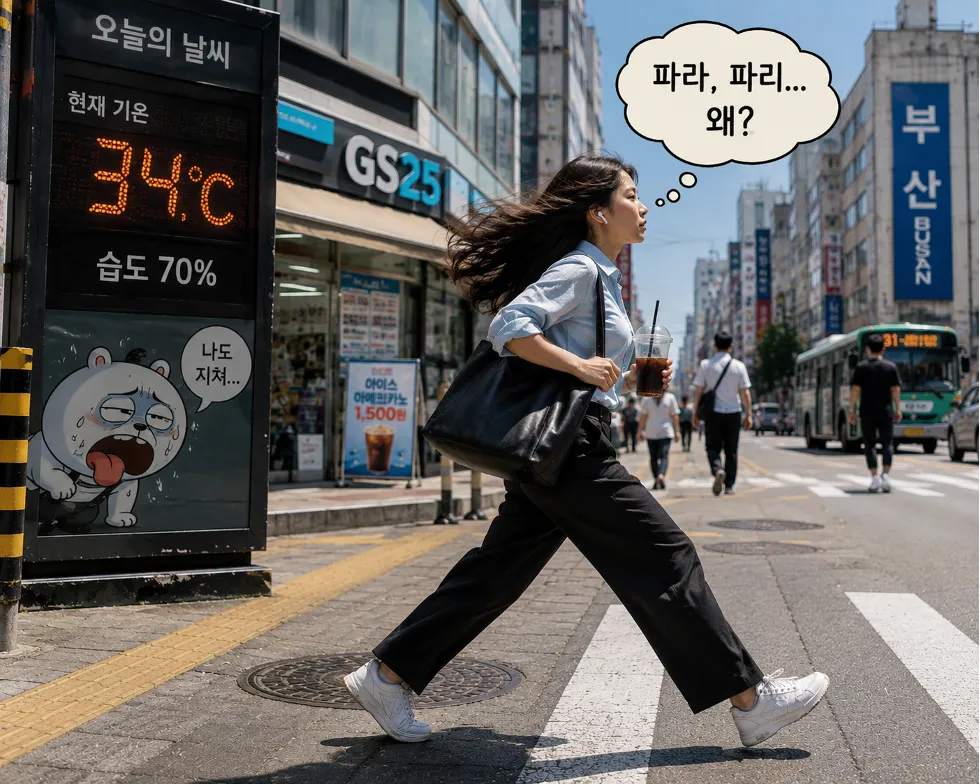
A woman came out of a convenience store. Outside: 34°C. Humidity somewhere between “tropical rainforest” and “inside a sauna.”
She stepped onto the pavement… and immediately accelerated.
Not a sprint. Not jogging. A determined, purposeful, almost military fast walk.
Twenty metres later, she slowed down.
There was no bus stop nearby, no train leaving, no emergency, and apparently no destination that required quite so much initial speed. Just… acceleration.
After nearly two years in Korea, I’ve stopped asking whether Koreans walk fast. Now I’m wondering why.
The Great Korean MysteryIf you come from Europe, you’ll probably notice it within a few days.
People leave the subway as if someone has just shouted, “Go!” They cross stations with remarkable determination. They press the elevator close-door button before the person entering has even turned around. They stand up in buses before the bus has stopped.
And yes… they often seem to hurry towards absolutely nothing in particular.
It isn’t necessarily stress in the Western sense. It isn’t panic. It is simply… Korea.
Is It in Their DNA?No.
Despite what first-time visitors might suspect, there is no evidence that Koreans are biologically programmed to move faster than everyone else.
In fact, historical accounts suggest something rather surprising. Until well into the twentieth century, Korea was often described by foreign visitors as rural, slow-moving and relatively unhurried.
So what changed? Almost everything.
From Ruins to Economic MiracleAfter the Korean War, South Korea had to rebuild on an enormous scale. Cities, roads, industry and institutions had all been badly damaged. The country was poor, resources were limited and development was urgent.
Time was not merely money. Time was national survival.
During the 1960s and 1970s, South Korea began one of the fastest periods of industrialisation in modern history: factories, roads, shipyards, steelworks, apartment blocks and electronics.
Everything had to be built—and preferably completed yesterday.
The so-called Miracle on the Han River did not unfold gradually over several centuries. Much of it happened within a few decades.
Speed became a virtue. Efficiency became a national habit.
And the phrase 빨리빨리 — ppalli ppalli, meaning “quickly, quickly,” became far more than a useful expression. It became a way of approaching life.
More Than Walking FastThe interesting thing is that ppalli ppalli is not really about running. It is about avoiding unnecessary delay.
Food delivery? Fast. Internet? Fast. Hospital tests? Often remarkably fast. Government paperwork? Sometimes completed before a European office has located the correct form.
Coffee? Ordered, prepared and handed over with such efficiency that you may briefly wonder whether the barista knew your order before you entered.
When everyone expects things to happen quickly, moving quickly becomes automatic—even when there is no deadline, the destination is only fifty metres away, and it is 34°C.
Competition Starts EarlyThere is also Korea’s competitive education and working culture.
Many children grow up with carefully managed schedules: school, academies, homework, tests and activities. Adults enter workplaces where responsiveness and visible effort are often highly valued.
Public transport runs frequently and usually punctually. Digital services are designed for speed. Deliveries arrive rapidly. Messages often receive quick replies.
Countless small moments reward efficiency. After enough years, fast no longer feels fast. It simply feels normal.
The Shadow SideEvery cultural strength has a less comfortable side.
Many Koreans themselves question whether ppalli ppalli sometimes goes too far. The pressure to move faster, answer faster, build faster and achieve faster can contribute to stress, fatigue and burnout.
Speed can also come at the expense of safety, patience or careful reflection.
South Korea’s rapid development produced extraordinary results, but it also created a society in which slowing down can sometimes feel suspiciously close to falling behind.
Back to the Woman Outside the Convenience StoreShe continued down the street. After her initial burst of speed, she settled into a perfectly ordinary walking pace—exactly the pace she could have started with.
Perhaps she had suddenly remembered something. Perhaps she was escaping the blast of hot air from the shop entrance. Perhaps she simply realised that running in 34-degree heat was not, after all, an essential part of the national development strategy.
Or perhaps ppalli ppalli had simply taken control for the first twenty metres.
Because that may be the real answer.
Koreans are not necessarily always in a hurry. They belong to a culture that spent decades learning that speed could change the country. And it did. The habit remained.
So when a Korean person suddenly races away from a subway exit, a café or a parked car, there may be no bus to catch, no urgent appointment and no clear destination.
They may simply be moving at the speed history taught them. At least for the first twenty metres. ;)