
Living at the Foot of Geumjeongsan
Oncheonjang aan de voet van Geumjeongsan: warmwaterbronnen met koninklijke geschiedenis, een park met gelaagd verleden en de bergen voor de deur. Mijn dagelijkse stukje stilte in Busan.
I sometimes think I live in one of the most beautiful parts of Busan.
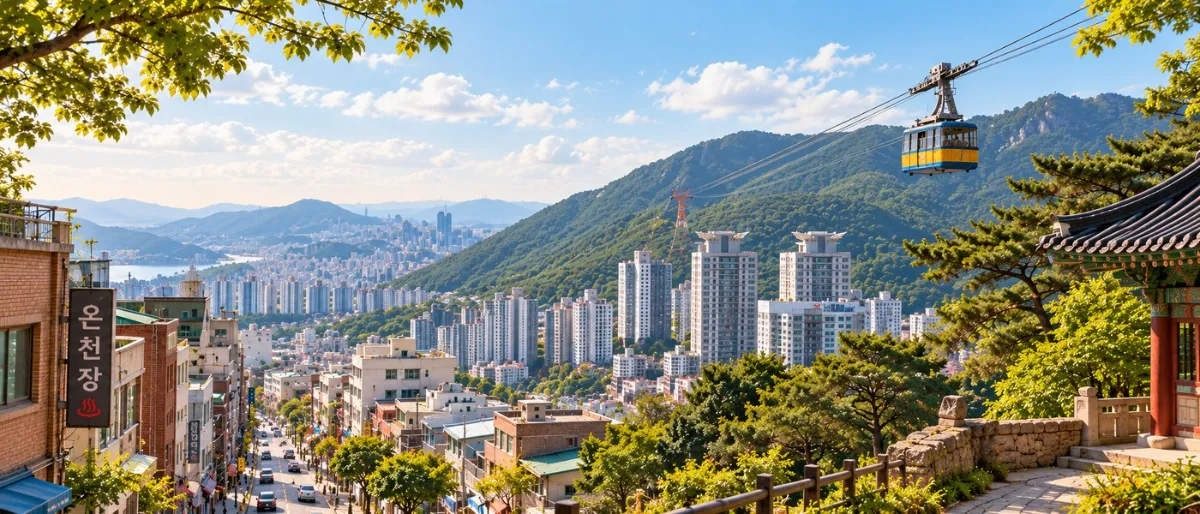
From our apartment in Oncheonjang I look straight towards Geumjeongsan. The mountain is simply part of the view. On clear mornings the ridges seem surprisingly close. On other days the top disappears completely into cloud.
What I enjoy most is how quickly I can get from the city into the mountain.
I leave home, walk past the apartment buildings and shops, and within a few minutes the noise begins to disappear. There are trees, narrow paths and small temples tucked away against the slope. Sometimes I hardly meet anyone.
That still surprises me. Busan is right there, only a short walk away, but for a while it feels much further.
Living here made me curious about Oncheonjang itself. Why did this particular part of Busan develop the way it did? Why are there so many spas here? And how did Geumgang Park, just above the neighbourhood, come to be?
The answer starts with the water.
A neighbourhood built around hot springs
The name Oncheonjang already gives part of it away. Oncheon means hot spring.
The Dongnae hot springs have been known for centuries. Old Korean records connect them with the Silla period, and during the Joseon dynasty members of the royal family travelled to Dongnae to bathe here. Historical records mention visits by Princess Jeongui, Yangnyeong Daegun and Imyeong Daegun.
There is also an old local story about an elderly woman who saw an injured crane recover after standing in warm water. She followed the bird and discovered the spring. It is a legend, of course, but one that has stayed with this area for a very long time.
The hot water is still here.
Close to our apartment is a pumping and distribution facility. Thermal water from the area is supplied from there to local hotels and spas. I pass it regularly, and it makes the old history of Oncheonjang feel rather less distant. The same hot water that brought people here centuries ago is still being used today.
Once you know that, the large spa complexes around Oncheonjang make much more sense.
Oncheonjang becomes a resort
Oncheonjang changed considerably around the beginning of the twentieth century.
Japanese businesses began investing in Dongnae Oncheon even before Korea was formally annexed by Japan in 1910. Bathhouses and accommodation were developed, roads improved, and the district became increasingly popular as a place for leisure.
During the colonial period, Japanese businessmen and landowners also built villas and recreational facilities around the hot springs.
That part of the history matters because it is still visible in Geumgang Park.
One of the people involved was the tobacco entrepreneur Higashibara Gajiro. In the 1920s he developed a private garden on the lower slopes of Geumjeongsan. Water from the valley was used for a Japanese-style pond and other garden features.
He also had Dokjindaeamun moved to the property. The gate had originally been part of the old Dongnae government complex.
Higashibara's property later became part of what is now Geumgang Park. The area was given the name Geumgangwon in 1940, and in 1965 it was formally designated as a public park.
I find that history interesting when walking there today. The park feels very Korean and very local now, but some of the things you see are connected to a much more complicated period in Busan's past.
Dokjindaeamun is a good example. It stands quietly among the trees, although that was never its original location.
The park today
Most people in Geumgang Park probably do not spend much time thinking about Higashibara Gajiro.
They are there to walk, exercise, meet friends or head further up the mountain. Hiking groups gather there. Older residents use the outdoor exercise equipment. Others sit down for coffee or spend some time under the trees.
That is the park I know.
There are sports facilities, the Busan Marine Natural History Museum and the Busan Folk Arts Center. Entry to the park itself is free, and from Oncheonjang Station it is roughly a fifteen- to twenty-minute walk.
The Folk Arts Center is easy to walk past without realising how interesting it is.
Traditional Dongnae performing arts are still practised there. Dongnae Hakchum, the local crane dance, is one of them. Dongnae Yaryu, the traditional mask drama of the district, is another. There are also performances of Dongnae Jishinbalgi, Dongnae Gomu and Dongnae Hallyangchum.
These are living traditions rather than displays from some distant past. Performances still take place in and around the park.
For me that is part of what makes Geumgang Park interesting. You can go there simply for a walk and discover bits of Dongnae history almost by accident.
The cable car
And then there is the cable car.
It has been running since 1966, and it certainly looks as if it comes from another era.
That is part of the fun.
The cabins are old-fashioned and the journey takes only a few minutes. As you climb, the buildings of Oncheonjang fall away beneath you and the mountain suddenly feels much larger.
As of September 2026, an adult ticket costs ₩7,000 one way and ₩11,000 return. The cable car normally closes on Mondays and may stop operating when the weather is bad.
You can take it simply for the ride and the view, although for hikers it is also a useful way of getting higher onto the mountain.
From the upper station you can walk towards the South Gate of Geumjeongsanseong and continue in the direction of Sanggyebong. There are plenty of other trails as well.
I sometimes prefer starting from the bottom. On another day I am perfectly happy to let the cable car do the first part.
That is perhaps the nice thing about Geumgang Park. You can spend an hour there and go home again, or you can keep walking and turn it into most of a day.
Geumjeongsan becomes a national park
Since 31 October 2025, Geumjeongsan has officially been South Korea's 24th national park.
The new Geumjeongsan National Park covers 66.859 square kilometres across Busan and neighbouring Yangsan. According to the national government, the area contains 1,782 recorded species and 127 cultural resources.
For those of us who already lived underneath it, the mountain itself did not suddenly become different on 31 October.
It was already the place people walked, climbed, rested and escaped to.
What did change was its official status. Geumjeongsan is now recognised and protected as a national park.
I rather like the idea that one of Korea's largest cities has a national park rising directly out of its neighbourhoods.
And Oncheonjang is a particularly easy place from which to discover it.
You can arrive by subway and walk through streets that grew up around hot springs used for centuries. A short distance further on is Geumgang Park, with its own rather unusual history. From there you can take the old cable car or simply keep walking uphill.
For me, of course, it is even easier.
I can step out of our apartment, walk towards the trees and, a few minutes later, leave most of Busan's noise behind.
Then I can walk home again.
That is a pretty good place to live.