
Why Are All Those Korean Flags Out?
Why are Korean flags suddenly lining the streets of Busan? A simple question about Liberation Day led me from Japan and 1945 to Korea’s division, North Korea — and even a railway that may one day point north again.
The flags are appearing along the streets of Busan again. I knew they had something to do with August 15. What I had never really considered was how much of modern Korea’s story is hanging behind them.
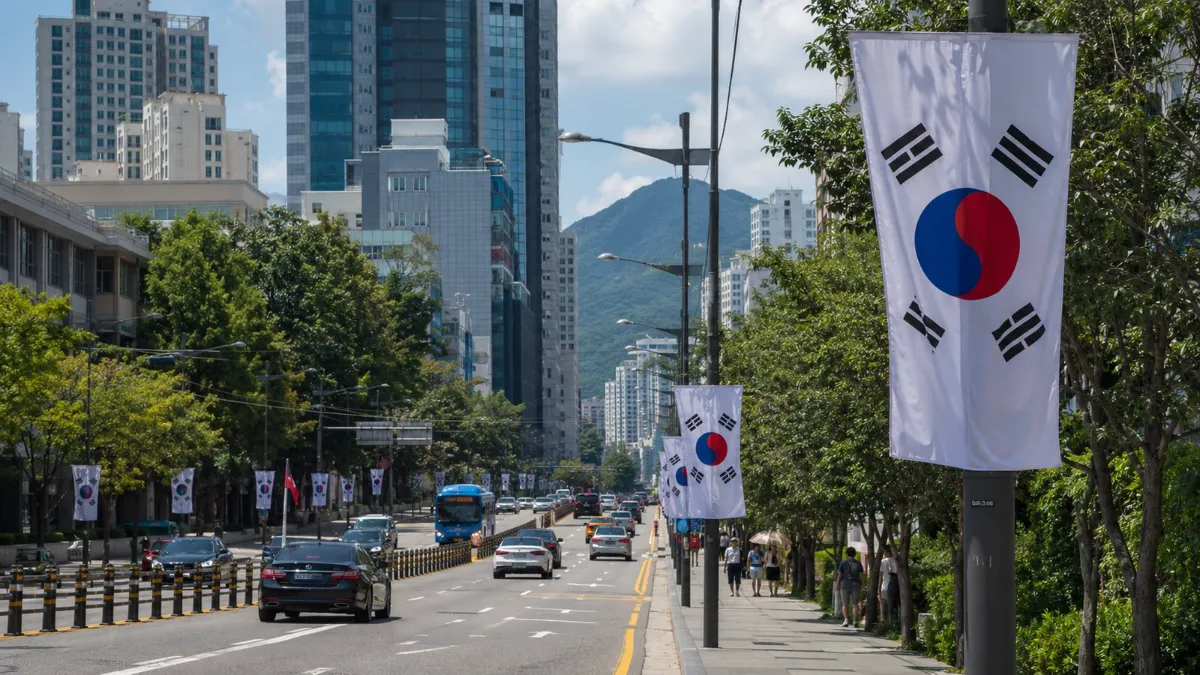
It is August 13 and today and I believe also yestrday the Korean flags were out in Busan.
You see them along the main roads, attached to lampposts in long rows. After almost two years of living here, I know by now that when the Taegeukgi suddenly starts appearing everywhere, there is usually something to celebrate or remember.
This time I knew what was coming. Well, more or less.
August 15 is Gwangbokjeol (광복절), Korea’s National Liberation Day. I knew that Korea had been occupied by Japan, that Japanese colonial rule ended in 1945 and that the relationship between Korea and Japan still occasionally becomes rather sensitive.
But seeing all those flags made me realise that I had never really thought much further than that.
What exactly are Koreans celebrating on August 15? How does a younger Korean who might happily fly to Fukuoka for the weekend relate to a national holiday celebrating liberation from Japan? And then another thought occurred to me: North Korea must have been liberated on exactly the same day.
As a Dutchman, I naturally began comparing it with our own Liberation Day on May 5.
So I started reading.
The day the light returned
Gwangbokjeol is sometimes called Korean Independence Day in English, although Liberation Day describes it better.
Japan formally annexed Korea in 1910 and ruled the peninsula for 35 years. Particularly during the later colonial period, Koreans were subjected to increasingly forceful assimilation policies. Korean language and identity came under pressure, many Koreans were mobilised for labour, and Korean women were among those subjected to the Japanese military’s wartime system of sexual slavery, commonly known as the “comfort women” system.
On August 15, 1945, Japan announced its surrender at the end of the Second World War. Japanese colonial rule over Korea came to an end.
The name Gwangbok is usually translated as “the restoration of light.”
I like that expression. It says rather more than simply “independence”. After 35 years in which Koreans did not control their own country, the light returned.
For older Korean families, that history is not actually very far away. Even people who did not experience the colonial period themselves may have grown up with parents or grandparents who did.
For younger Koreans, the relationship with that history — and particularly with present-day Japan — can look rather different.
Japan: history and a weekend in Fukuoka
This is one of the things I have found interesting since moving to Korea.
Historical disagreements with Japan certainly have not disappeared. Forced labour, the wartime “comfort women” issue, Dokdo/Takeshima and arguments about how colonial history is remembered can still create serious political friction.
Then you look at everyday Korea.
Japanese restaurants are everywhere. Japanese music, manga, anime, fashion and products are completely normal. Young Koreans travel to Japan in huge numbers and, from Busan, Fukuoka is so close that it can feel more like a weekend destination than a foreign country.
Recent Korean public-opinion research also shows that attitudes towards Japan have become considerably more positive. In August 2026, East Asia Institute research reported record-high favourable impressions of Japan and evaluations of the Korea-Japan relationship since its survey series began. The Asan Institute found something similar earlier this year: Japan’s favourability score among South Koreans moved above the neutral midpoint for the first time in its survey.
That does not mean the past has suddenly been forgotten. It simply means that history and present-day life can exist alongside each other.
A Korean in their twenties can consider what Imperial Japan did to Korea completely unacceptable and still be excited about a flight to Osaka next month.
That seems pretty human to me.
Then North Korea entered my thoughts
The more I read, the more obvious another point became.
North Korea celebrates August 15 too.
Of course it does, when you think about it.
In August 1945 there was no North Korea and South Korea. There was Korea. The entire peninsula was liberated from Japanese colonial rule at the same time, and August 15 is still commemorated on both sides of today’s border.
The North tells the history differently and gives a much more prominent role to Kim Il Sung and the anti-Japanese guerrilla struggle. But the basic event being commemorated is the same: the end of Japanese colonial rule.
That is when Gwangbokjeol began to look rather different to me from Dutch Liberation Day.
Because Korea was liberated in 1945, but it did not then continue as one liberated country.
After Japan’s surrender, Soviet forces entered the northern part of the peninsula and American forces occupied the south. The division around the 38th parallel hardened, separate governments were established in 1948 and, in 1950, the Korean War began.
The fighting ended in 1953 with an armistice, not a peace treaty.
So Korea regained its freedom from Japan and almost immediately entered another chapter of its history — division.
That made me think of May 5
In the Netherlands, we celebrate Bevrijdingsdag, Liberation Day, on May 5. There is an obvious connection with Gwangbokjeol. Both Korea and the Netherlands experienced occupation during the Second World War, both regained freedom in 1945 and both now have younger generations who know occupation from family stories, museums and history books rather than personal experience.
But there is one enormous difference.
The Netherlands was liberated and remained one country. Korea was liberated and was divided.
For Dutch people, 1945 largely marks the end of occupation and the beginning of rebuilding a free country.
For Koreans, liberation was followed almost immediately by the political division that eventually produced two completely different states.
And that division is not simply something in a history book.
Sometimes Korea reminds you where you are
Most days in Busan, North Korea feels remarkably far away.
People go to work, meet friends, complain about the heat, drink coffee, take the subway and wonder what to have for dinner. Daily life does not feel like life in a country technically still at war.
Then something happens.
On August 11, North Korea launched another ballistic missile from the Wonsan area, on its east coast. South Korean and Japanese defence authorities said it travelled roughly 700 kilometres before coming down in the sea. It was the eleventh suspected North Korean ballistic-missile test of 2026 according to South Korean assessments.
A few days after Liberation Day, South Korea and the United States will also begin their annual Ulchi Freedom Shield military exercises. This year’s training includes responses not only to conventional military threats but also to drones, GPS interference, electronic warfare and cyber attacks.
South Korea continues to strengthen its military because the North Korean missile and nuclear threat is real.
And yet, almost at the same time, I came across a completely different story.
A railway.
A railway pointing north
On August 5, the South Korean government announced that work would resume on part of the Gyeongwon railway line near the Demilitarized Zone. Work on the project had been suspended for about a decade.
Historically, the railway ran from Seoul towards Wonsan — yes, the same Wonsan that appeared in the missile news only days later.
Nobody is suggesting that we will soon be boarding a train in Seoul for a weekend on North Korea’s east coast. The work is on the South Korean side, North Korea has not agreed to reconnect anything and relations between the two governments remain extremely poor.
Still, South Korea has decided to restore the line.
That detail stayed with me.
A missile is launched from Wonsan. South Korea prepares militarily for the threat from the North. At the same time, it repairs railway tracks which, in a very different future, could once again point towards Wonsan.
Perhaps those things are not as contradictory as they first seem.
You can prepare yourself for things to become worse while still hoping that, one day, they might become better.
Back to the flags in Busan
And that brings me back to where this started: the flags hanging from the lampposts outside.
For many Koreans, August 15 will of course also simply be a welcome national holiday in the middle of a hot summer. People will meet family, go somewhere for the day or enjoy having some time off.
But behind that holiday sits an extraordinary amount of history.
Older Koreans may have family memories that connect directly with Japanese colonial rule. Younger Koreans often have a much easier relationship with modern Japan. North Korea commemorates the same liberation while now being separated from the South by one of the world’s most heavily guarded borders.
And somewhere near that border, South Korea is once again repairing an old railway that heads north.
Before looking into all this, I would probably have described Gwangbokjeol in one sentence: Korea celebrates its liberation from Japan in 1945.
That is perfectly correct.
It just isn't the whole story.
The Netherlands was liberated in 1945 and remained one country. Korea was liberated in 1945 and was divided.
Perhaps that is what I will think about when I see all those Taegeukgi again next August.
There is rather more history hanging from those lampposts than I realised.
Want to go a little deeper?
Once I started looking into Gwangbokjeol, I found myself going much further than I had intended. Korea’s division, its changing relationship with Japan, North Korea’s nuclear and missile threat, South Korea’s rapidly changing defence strategy and the latest attempts to reopen dialogue all belong to the same wider story.
That became far too much for one OurBusan.life article.
For readers who are curious, I have therefore written a separate long-form reflection:
Liberated but Divided: Korea’s Search for Security, Reconciliation and Peace
It goes further into the history and into what is happening around the Korean Peninsula right now — including the rather extraordinary contrast between missiles, military modernisation and that railway towards Wonsan.
The Long Read reflects the geopolitical situation as of August 2026.
Sources
For the historical and contemporary background to this article I consulted Korean government and museum sources on Gwangbokjeol and the colonial period, public-opinion research from the East Asia Institute and Asan Institute, information from the Dutch National Committee for 4 and 5 May, and current Reuters reporting on North Korea, inter-Korean relations and the Gyeongwon railway project.