

What Lies Beneath Busan? The Surprising History of Our Subway
What lies beneath Busan’s subway? From a 400-year-old battlefield discovered during construction to driverless trains, deep underground stations and future expansion plans, I explore the surprising stories behind my everyday metro rides.
Ancient battlefields, unexpected discoveries and remarkable engineering. There's more to Busan's subway than simply getting from A to B.
It started with an ordinary subway ride
A few times a week, I take Line 1 from Oncheonjang towards downtown Busan. It's convenient, affordable and generally reliable. Certainly more relaxing than sitting in traffic.
Like most passengers, I usually know where I need to get off and which exit to take. I don't give much thought to how the subway got there in the first place.
Recently, though, I started wondering about it.
Busan is hardly the easiest place to build an underground railway. There are mountains, rivers, busy neighbourhoods and a coastline. How did they manage it? When did construction begin? And did they find anything interesting while digging?
I expected a few dates and some engineering details.
What I discovered was rather more interesting.
A battlefield beneath a subway station
Suan Station (수안역) on Line 4 has something that most subway stations don't: a history museum inside the station itself.
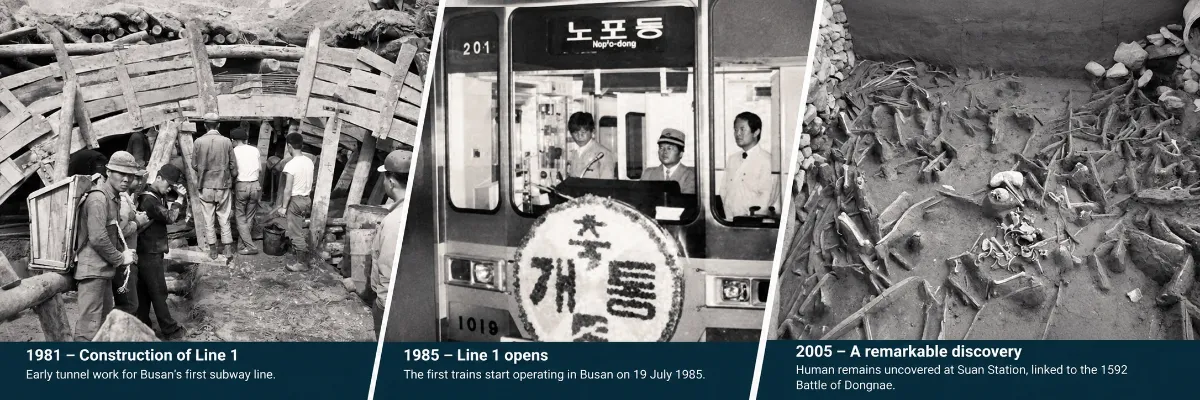
In April 2005, during preparations for construction, workers discovered an old stone structure. Archaeologists subsequently identified remains of the defensive moat that once surrounded Dongnae Fortress.
What started as a subway construction project had become a significant archaeological excavation.
Over the following years, archaeologists uncovered weapons, armour, arrowheads and the remains of around 100 people associated with the Japanese invasion of Korea in 1592, known as the Imjin War (임진왜란).
Dongnae was one of the places attacked as Japanese forces advanced into Korea. Its defenders resisted, but the fortress eventually fell.
More than four centuries later, the excavations revealed disturbing evidence of that battle. Some skulls showed injuries caused by weapons. Among the remains were those of women and children.
I find that quite extraordinary.
Imagine working on a modern subway station and suddenly discovering evidence of a battle fought more than 400 years earlier.
And all of this beneath streets where thousands of people now go about their daily lives.
The discovery also created a practical problem. Archaeologists needed time to investigate and document the site, while the construction project had to continue. Excavations took place in several stages between 2005 and 2008.
Fortunately, the story didn't end with everything being removed to make way for the trains.
On 28 January 2011, the Dongnae Eupseong Imjin War History Hall (동래읍성 임진왜란 역사관) opened at Suan Station.
The exhibition tells the story of the Battle of Dongnae and presents archaeological discoveries, reconstructions and a display of the old moat.
I haven't visited it yet, but I certainly intend to.
I rather like the idea that you can go down to catch a subway train and unexpectedly find yourself face to face with a piece of Busan's much older history.
How it all began
Busan's subway is, of course, considerably younger than the history uncovered at Suan.
The city began planning its subway network in the late 1970s. Construction of Line 1 started on 23 June 1981, and the first section opened on 19 July 1985.
Busan became South Korea's second city with a subway system, following Seoul.
The original operating line ran for approximately 16.2 kilometres between Beomeosa and Beomnaegol. The section north to Nopo opened later, in December 1986.
Interestingly, Oncheonjang Station, where I usually begin my journeys, was already part of that original route.
That means the line I use today has been carrying passengers for more than forty years.
Over time, Line 1 was extended through the city, reaching Jungang in 1987 and eventually Dadaepo Beach in April 2017.
I sometimes wonder what passengers thought when those first trains started running.
Busan in 1985 was a very different city. There were no smartphones, navigation apps or today's extensive public transport connections.
For people accustomed to travelling by bus through busy streets, the subway must have been quite an improvement.
According to Busan Transportation Corporation's historical records, a journey that previously took around 50 minutes by bus could be completed in approximately 28 minutes by subway.
That's quite a difference, especially if you make the same journey every day.
Not everything is underground
Despite its name, not all of Busan's subway runs beneath the streets.
Around Oncheonjang, Line 1 travels on elevated tracks. Later, heading towards the city centre, the train disappears underground.
That mixture makes sense when you look at Busan's geography.
The city is built around hills and mountains, and there isn't always an easy or straightforward route between neighbourhoods.
One particularly interesting example is Mandok Station (만덕역) on Line 3.
Its platforms are approximately 64 metres below ground level, making it one of the deepest subway stations in South Korea.
In fact, the platforms are on the ninth underground level. Reaching the trains involves a rather long journey by escalator or lift.
I've never made a special trip there, but now I'm curious.
Not because I particularly enjoy long escalator rides, but because I'd like to experience what a station that deep actually feels like.
A subway without a driver
Line 4, which includes Suan Station, is different in another way.
When it opened on 30 March 2011, it introduced South Korea's first fully automated, driverless light-rail system of its kind.
Unlike conventional subway trains, Line 4 uses rubber tyres rather than steel wheels. The trains operate without drivers.
The line runs between Minam and Anpyeong.
For passengers, the absence of a driver is probably the most noticeable difference.
It also illustrates how much Busan's public transport system has changed since the first trains started operating in 1985.
I wonder whether passengers travelling on those early Line 1 trains ever imagined that Busan would have driverless trains within a few decades.
And what comes next?
Busan certainly isn't finished developing its rail network.
In June 2026, the South Korean government approved Busan's Second Urban Rail Network Plan, covering the period from 2026 to 2035.
It identifies ten proposed railway projects, totalling approximately 145.7 kilometres, including new connections serving areas such as Songdo, Gangseo and Gijang.
Among the proposals are express services on Lines 1 and 2, which could make longer journeys across Busan considerably more convenient.
Another ambitious project is BuTX, a proposed rapid railway intended to connect important destinations across the city, including the future Gadeokdo airport and Osiria.
The proposed journey time from the airport area to Osiria is just 33 minutes. That would be quite a change from travelling across Busan today.
Of course, there is a difference between an approved plan and a completed railway.
Further studies, financing and construction decisions are still needed. And anyone familiar with major infrastructure projects knows that completion dates can change.
Nevertheless, I would certainly welcome faster connections across Busan.
Depending on where you live and where you need to go, travelling from one side of the city to the other can take quite some time.
A different view of a familiar journey
I started looking into Busan's subway because I use it regularly and realised how little I actually knew about its history.
I expected to learn something about construction methods, opening dates and perhaps a few technical difficulties.
Instead, I discovered that one station contains evidence of a battle fought in 1592, another takes passengers deep beneath a hillside, and an entire subway line operates without drivers.
It has changed the way I think about those familiar stations on the subway map.
The next time I travel from Oncheonjang, I'll probably do what I always do: look for a seat, check the station names and make sure I don't miss my stop.
But I suspect I'll pay a little more attention along the way.
And one of these days, I really should get off at Suan Station.
There's a small museum there that I would very much like to see. :)
Historical information
-
Busan Transportation Corporation (Humetro) — History of the Busan Metro.
-
Yonhap News Agency — Opening of the Dongnae Eupseong Imjin War History Hall at Suan Station.
-
Korea Tourism Organization — Visitor information about the archaeological exhibition.
-
Yonhap News Agency — Busan's urban rail development plans, 2026–2035.