


Of Course I’m Insured! … Aren’t I?
Are you really enrolled in Korea’s National Health Insurance? Learn how coverage works for foreign residents, employees and families, why the six-month rule doesn’t apply to everyone, and how to check your registration, starting date and premiums.
Understanding Korean Insurance — Part 2
You live in Korea, have a residence card, perhaps a job and even an insurance deduction on your payslip. So, you're insured. Right?
In my first article for OurBusan.Life, I explored the sometimes confusing world of insurance for foreigners in Korea. One finding from our survey of more than 80 foreign residents stood out: having insurance and knowing exactly what you're insured for are two rather different things.
For Part 2, let's start with a more basic question: are you actually registered for National Health Insurance?
"Of course!" you might say. "My employer deducts health insurance from my salary every month."
Fair enough. But your job, residence status and family circumstances can affect how—and when—you become insured. And knowing where you stand is important, particularly when your circumstances change.
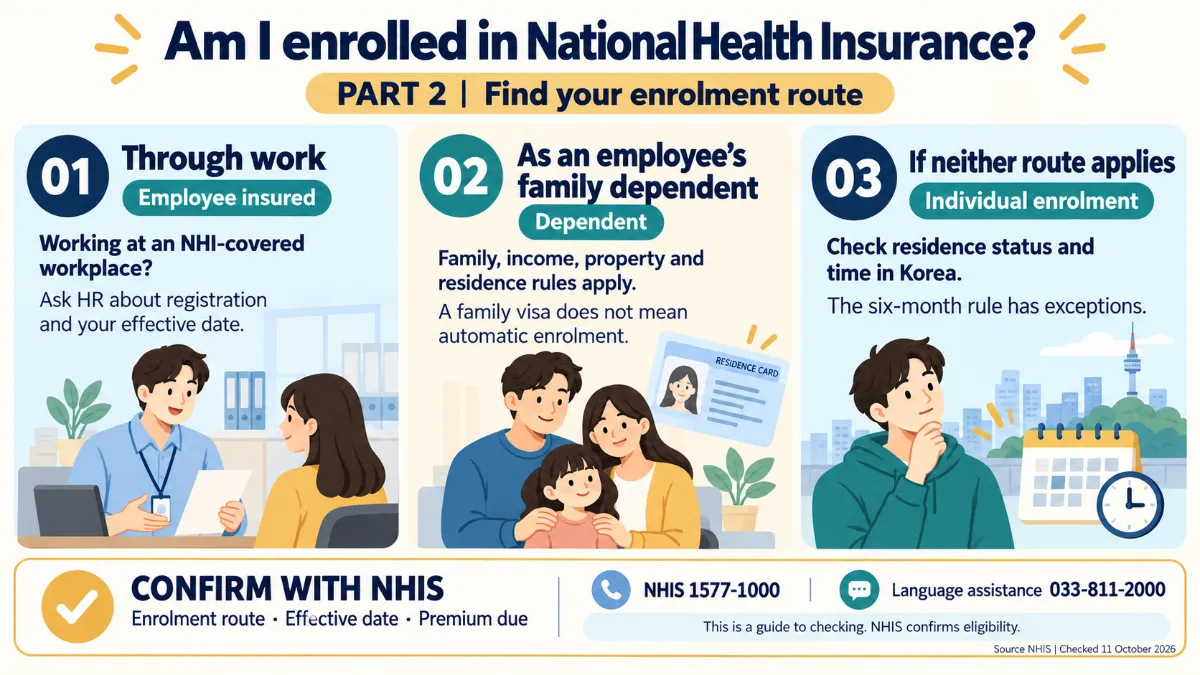
Working for a company
Alex has recently moved to Busan and started working for a Korean company. His payslip shows a health insurance deduction, so he assumes everything is arranged.
And quite possibly, it is.
Foreign employees working at a workplace covered by National Health Insurance generally become employee insured, provided they meet the relevant requirements. In Korean, this is called 직장가입자.
The employer reports the employee's eligibility to the National Health Insurance Service, or NHIS. The employer and employee generally each pay half of the wage-based health insurance premium.
A payslip deduction is certainly reassuring. But it doesn't independently confirm what NHIS has actually registered in your name.
For example, Alex may know that his company has arranged insurance, but does he know the official starting date? Has his registration been completed correctly? And if he changes employers, does he know whether his insurance status has been updated?
These details matter because your official NHIS record determines your current eligibility. The date is particularly worth checking when you have recently started a job, changed employers or moved from another insurance category.
Alex could start by asking HR:
"Has my National Health Insurance registration been completed, and from what date?"
HR can explain what the company has arranged. NHIS can confirm what is actually registered.
There's no reason to assume something has gone wrong. It's simply better to know than to rely on what you think has been arranged.
Not employed by a company
Alex's friend Maya does not work for a Korean company. She may be studying, freelancing or looking for her next job.
That doesn't necessarily mean she isn't insured.
Eligible residents who are neither employee insured nor registered as an employee's dependent may qualify as 지역가입자. The official English term is self-employed insured, although this category also includes eligible people who are not self-employed.
For clarity, let's call it individual enrolment.
NHIS automatically enrols many foreign residents once they meet the requirements. You may therefore be registered even if you haven't submitted an application yourself.
That is convenient, but it can also cause some confusion.
Suppose Maya hasn't received a health insurance bill. She might assume that her insurance hasn't started yet. Perhaps she's still waiting for the six-month residence period to end.
But not receiving a bill doesn't mean you are uninsured. A letter may have gone to an old address, or your apartment details may be incomplete.
The important point is that eligibility and receiving correspondence are two different things. You may already be registered and have premiums to pay without realising it.
And those premiums work differently from Alex's.
Individually insured residents generally pay their own premiums. The amount depends on the applicable rules, including income, property and residence status. Average-premium rules can also apply to foreign residents, so having no income doesn't automatically mean there's nothing to pay.
That makes it worth checking your position even when you haven't received any communication from NHIS.
Maya's first questions should be:
"Am I registered for National Health Insurance? And do I have any premiums to pay?"
Living with family
Now let's return to Alex.
His spouse has moved to Korea with him. They've arranged the immigration paperwork, live at the same address and naturally assume that their family arrangements are in order.
But does that mean Alex's spouse is covered under his health insurance?
Possibly—but not automatically.
An eligible family member can be registered as an employee-insured person's dependent, called 피부양자 in Korean. An approved dependent does not pay a separate health insurance premium.
That can make an important difference to a family's monthly expenses.
However, eligibility depends on recognised family relationships, income, property and other requirements. Overseas family documents may also need authentication and a Korean translation. Check with NHIS before paying to prepare them.
There are residence requirements to consider as well.
Since 3 April 2024, additional rules have applied to many foreign nationals and overseas Korean nationals seeking dependent registration. Spouses and children under 19 of employee-insured people are exempt from the six-month residence requirement, but other eligibility conditions still apply.
Here's something I particularly want international families to understand.
Permission to live in Korea as someone's family member is different from registration as their health insurance dependent.
Immigration permission deals with your right to stay in Korea. NHIS registration determines whether you qualify for coverage under the public health insurance system.
One doesn't automatically complete the other.
Dependent registration also belongs to the employee-insured system. An individually insured person cannot add family members under the same dependent arrangement.
So if you're relying on your spouse's health insurance, don't just assume that marriage or a family residence status is sufficient. Check whether your dependent registration has actually been completed.
The six-month rule
You may have heard that foreigners must live in Korea for six months before joining National Health Insurance.
That rule does apply to some foreign residents, but certainly not everyone.
Employee insurance follows different eligibility requirements. Individual enrolment also has exceptions.
Certain residence categories—including D-2 university students, D-4-3 school pupils, E-9 workers, F-5 permanent residents and F-6 marriage immigrants—can qualify without waiting six months, subject to the relevant registration rules.
Let's take students as an example.
Two students could arrive in Korea on the same day, both planning to study here for an extended period. One holds D-2 status for university studies. The other holds a general D-4 training status.
Although both are students, their health insurance eligibility may begin on different dates.
D-2 students can qualify from entry, subject to the registration requirements. General D-4 training status, other than D-4-3, generally follows the six-month rule.
The date of foreigner registration also matters. For categories eligible from entry, NHIS uses the registration date when foreigner registration takes place later than arrival.
This is why simply counting six months from the day you landed in Korea may give you the wrong answer.
The situation can become more complicated if you change your residence status or leave Korea and later return. In those cases, it's sensible to ask NHIS to confirm the date that applies to you.
The lesson is straightforward: someone else's experience with Korean health insurance may be perfectly correct for them, but it doesn't necessarily apply to you.
Insurance from home
You may already have international medical insurance, an employer-provided overseas plan or a policy from your home country.
Does that mean you can avoid joining Korean National Health Insurance?
Not necessarily.
Certain qualifying overseas insurance or employer-provided arrangements may allow exclusion from Korean National Health Insurance. But having another policy doesn't automatically make you exempt.
The relevant coverage requirements and application procedures must be met. NHIS also has specific conditions concerning when an overseas insurance policy was taken out.
If an NHIS bill arrives, don't put it aside simply because you already pay for insurance elsewhere. First check whether Korean enrolment is compulsory in your situation and whether an exclusion is available.
We'll return to overseas insurance and overlapping coverage in Part 6. It's an important subject, particularly for foreign residents who already have insurance through an employer or a policy from another country.
Three things to check now
By now, you've probably realised that National Health Insurance isn't quite the same for everyone living in Korea.
But you don't need to become an insurance expert to find out where you stand.
Start by asking NHIS to confirm three details:
Registration category: Am I employee insured, individually insured or registered as a dependent?Starting date: When did my current insurance eligibility begin? Payment obligations: Do I have any premiums or outstanding amounts to pay?
The date your eligibility begins is called 자격취득일 in Korean.
Have your residence card ready, along with your entry or re-entry date, residence status and relevant employment or family details.
You can contact the National Health Insurance Service directly:
NHIS: 1577-1000
English-language assistance: 033-811-2000
You can keep your request simple:
"I'd like to check my current National Health Insurance status, when my eligibility began and whether I have any premiums to pay."
Once you've checked your registration, you know where you stand. And that's a good start.
But being insured doesn't mean every visit to the hospital is free.
So here's another question worth asking:
"If I'm already paying for National Health Insurance, why do I still have to pay at the hospital?"
That's what we'll look at in Part 3: what National Health Insurance actually covers, what you pay yourself, and why the difference matters.
Sources and further reading
This article is based on Korean legislation and official National Health Insurance information.
Individual eligibility, registration dates, exclusions and premiums must be confirmed with NHIS.
Alex and Maya are fictional characters used for illustrative purposes.