
Hot Water Beneath Our Feet.
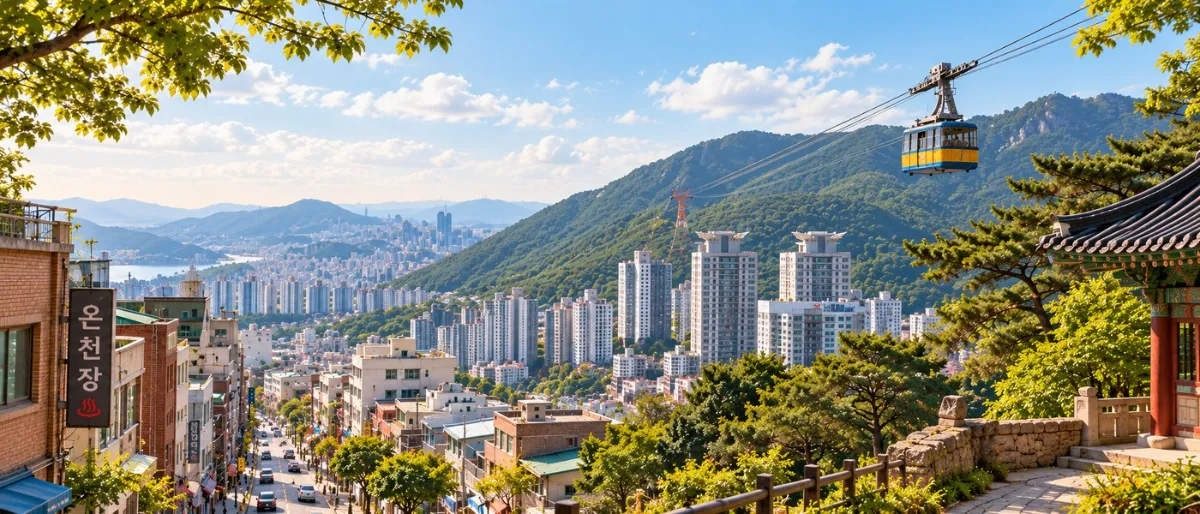
Oncheonjang: centuries-old hot springs, a park shaped by history, and Geumjeongsan rising just beyond the neighbourhood.
Another Surprise in Oncheonjang.
One of the nice things about living in Busan is that you keep discovering things, sometimes just around the corner from your own home.
We live in Oncheonjang, at the foot of Geumjeongsan. It's a neighbourhood I've become quite fond of. We have the mountains nearby, Geumgang Park within walking distance, plenty of small restaurants and, of course, the famous hot springs.
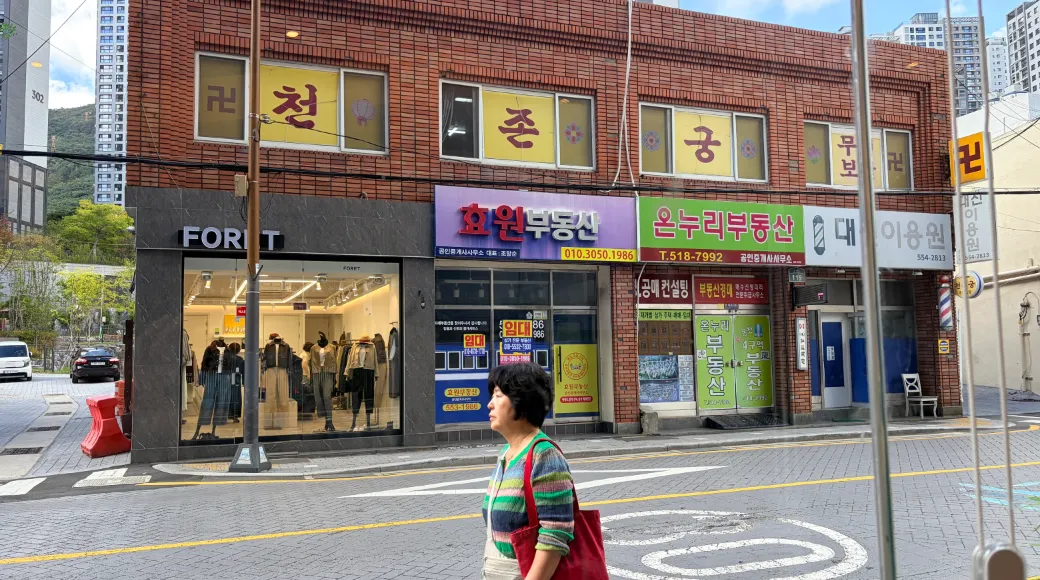
I knew about those hot springs, naturally. You can't really live in Oncheonjang without noticing the many bathhouses and saunas. And there's Heosimcheong, one of Busan's best-known spa complexes, just around the corner. I also knew that the area had quite a history. But somehow I'd never taken the time to find out much about it.
Until today.
Some time ago, I noticed a rather strange building in one of the streets nearby. It looked like some kind of pumping station. Nothing particularly attractive, and certainly not something you would stop to admire. But I had wondered what it was doing there.
Today, I noticed it again. Or rather, I heard it.
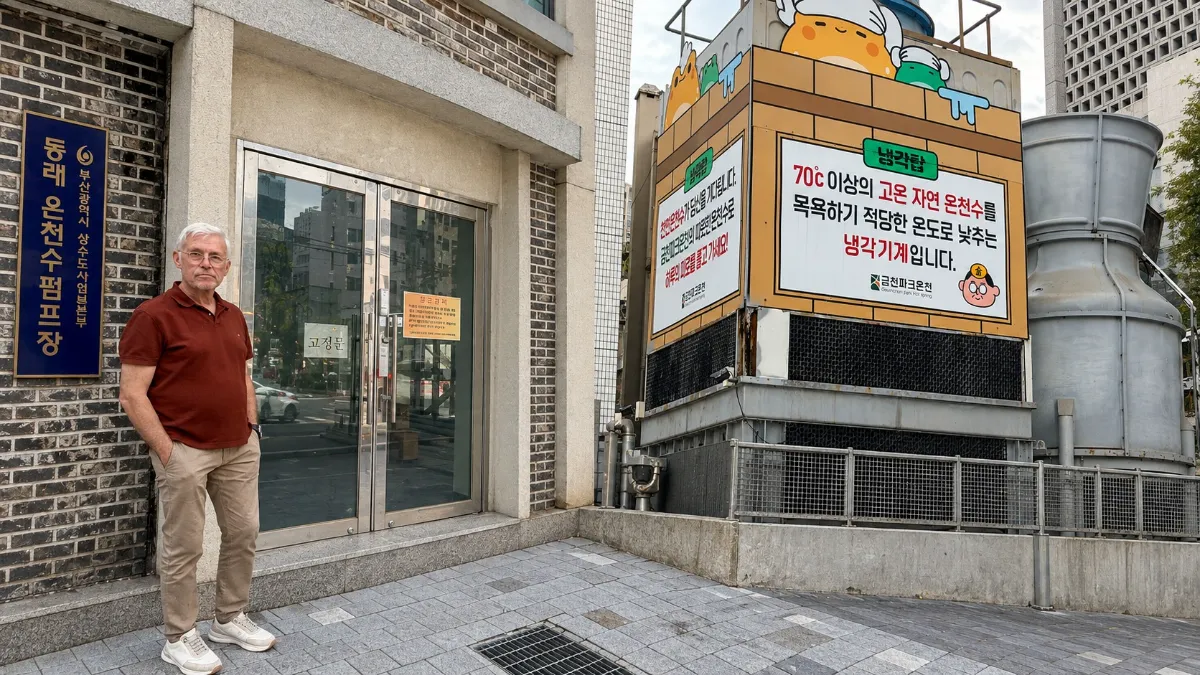
Quite a lot of noise was coming from behind the building, and when I went to have a look, I discovered a large steel installation with what looked like steam rising from it.
Now, that made me curious.
Someone told me that the installation was used to cool down the hot spring water before it was supplied to the local bathing facilities. Apparently, the water comes out of the ground at around 70 degrees Celsius.
Seventy degrees!
I knew the water was hot, of course. That's why they call them hot springs. But I hadn't realised it was that hot.
Fortunately, there was a large sign on the installation. In Korean, naturally, but my Korean is slowly improving. And with a little help from translation technology, I discovered what it said.
It explained that the machine cools natural hot spring water from more than 70°C to a suitable temperature for bathing.
So that mystery was solved.
The building next door also had a sign: 동래 온천수 펌프장, or Dongnae Hot Spring Water Pumping Station. It belongs to the Busan Metropolitan City Waterworks Headquarters.
There it was, right in our own neighbourhood. The machinery that helps make use of the hot water beneath Oncheonjang.
But where does all that hot water come from?
Seventy degrees. How is that possible?
The explanation is rather interesting.
Water finds its way underground through cracks in the rocks. As it travels deeper, it encounters warmer rocks and gradually heats up. The heat comes from inside the Earth.
In Busan, there's another interesting detail. According to Korea's national water-information portal, the local thermal water is partly linked to seawater that has travelled deep underground. There it was heated before mixing with cooler groundwater on its way back towards the surface.
The source even describes temperatures of up to 150°C during that underground journey.
And here is something I certainly didn't know. In Dongnae, the hot spring water is generally pumped from wells less than 200 metres deep.
That doesn't mean the water has only travelled 200 metres underground. Its route through the rocks can be much longer, and the water may have circulated much deeper before reaching the wells.
So, what's the temperature when it reaches us?
According to a Korean government announcement published earlier this month, Dongnae's hot spring water reaches 70.3°C. That makes it the second hottest reported hot spring water in South Korea. Only Bugok Hot Springs in Changnyeong, at 78°C, is hotter.
The water contains dissolved minerals, including calcium and magnesium, and is mildly alkaline.
And why does all this happen here, in Oncheonjang?
Because the rocks beneath this area contain cracks and underground pathways through which heated water can move upwards. Over a very long period, groundwater has circulated through this natural system, taking up heat before returning towards the surface.
So, while we're going about our daily lives, shopping, having coffee or walking through the neighbourhood, hot water is being pumped from the ground beneath us.
I find that quite remarkable.
And it also explains why that noisy machine is needed.
Water at 70°C is much too hot for bathing. It can cause serious burns. The temperature has to be reduced considerably before anyone can safely get into it.
The installation I photographed does exactly that. Its sign confirms that it cools the water to a suitable bathing temperature.
The actual cooling process is based on a simple principle: heat moves from something warmer to something cooler. Cooling equipment allows the hot water to release some of its heat.
The visible clouds around such equipment can be caused by warm, moist air meeting cooler outside air, forming tiny droplets.
I don't yet know precisely how this particular cooling system is built, or which nearby bathing facilities it serves. But at least I now know what the machine is there for.
And that discovery made me curious about something else.
How long have people been using this water?
Even Korean kings came here
Quite a long time, as it turns out.
The history of the Dongnae hot springs goes back around 1,400 years, to the Silla period.
One of the oldest written references appears in the Samguk Yusa, a Korean collection of historical accounts and legends. It mentions that a high-ranking official named Chungwongong visited the hot springs during the reign of King Sinmun, who ruled from 681 to 692.
Other historical writings tell us that Silla kings also visited Dongnae to bathe in the hot water.
Apparently, our neighbourhood was already a popular place for a good bath long before Busan became the modern city we know today.
There is also a rather nice local legend about how the springs were discovered.
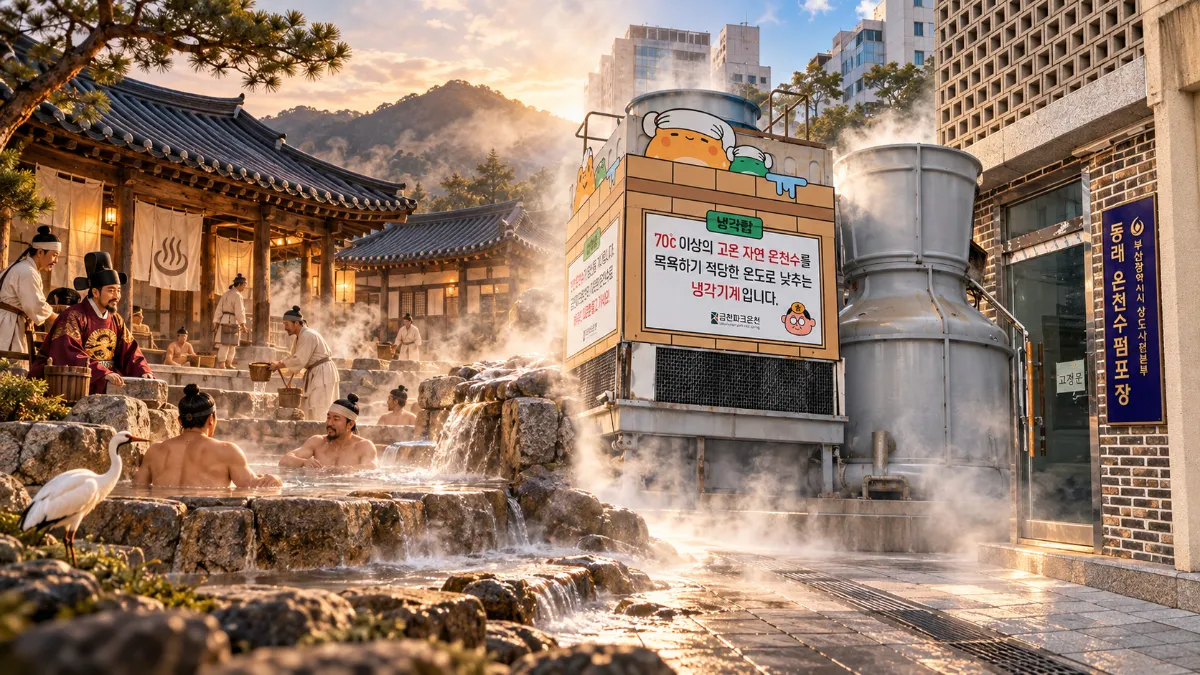
According to the story, an elderly woman noticed a white crane with an injured leg. The bird kept returning to the same place, where it spent time in the warm water. After several days, its leg appeared to have healed.
The woman, who also had trouble walking, decided to try the water herself. According to the legend, her leg improved too.
And that's how people supposedly discovered the special qualities of the hot spring.
There is another version involving a white deer that regularly rested in a particular spot. When people investigated the place, they discovered warm water coming from the ground.
Of course, these are legends. Nobody can tell us whether the crane or the deer really existed.
But I rather like these old stories. They show how people tried to explain something unusual in nature long before there was any scientific understanding of underground water systems.
As time went on, the hot springs became more organised.
During the Joseon period, proper bathing facilities were built. In 1766, a local magistrate named Gang Pil-ri had the old baths rebuilt.
According to the historical records, he arranged for two stone bathing pools and a building with separate bathing areas for men and women.
And there's still something left from those days.
A stone monument called Onjeong Gaegonbi (온정개건비) was erected in 1766 to remember the reconstruction. It still stands in Oncheonjang today.
The old records even describe the water as being hot enough to cook an egg!
Imagine that. Almost 260 years ago, people were already improving the bathing facilities here.
And today, just a few streets away, we're using modern cooling equipment to deal with the very same problem: water that is simply too hot to bathe in.
The name says it all
I also looked into the name of our neighbourhood.
온천 (oncheon) means hot spring in Korean, while 장 (jang) in Oncheonjang refers to the hot spring resort or bathing area.
So the name basically tells us what the neighbourhood is famous for.
Perhaps I should have paid more attention during my Korean lessons!
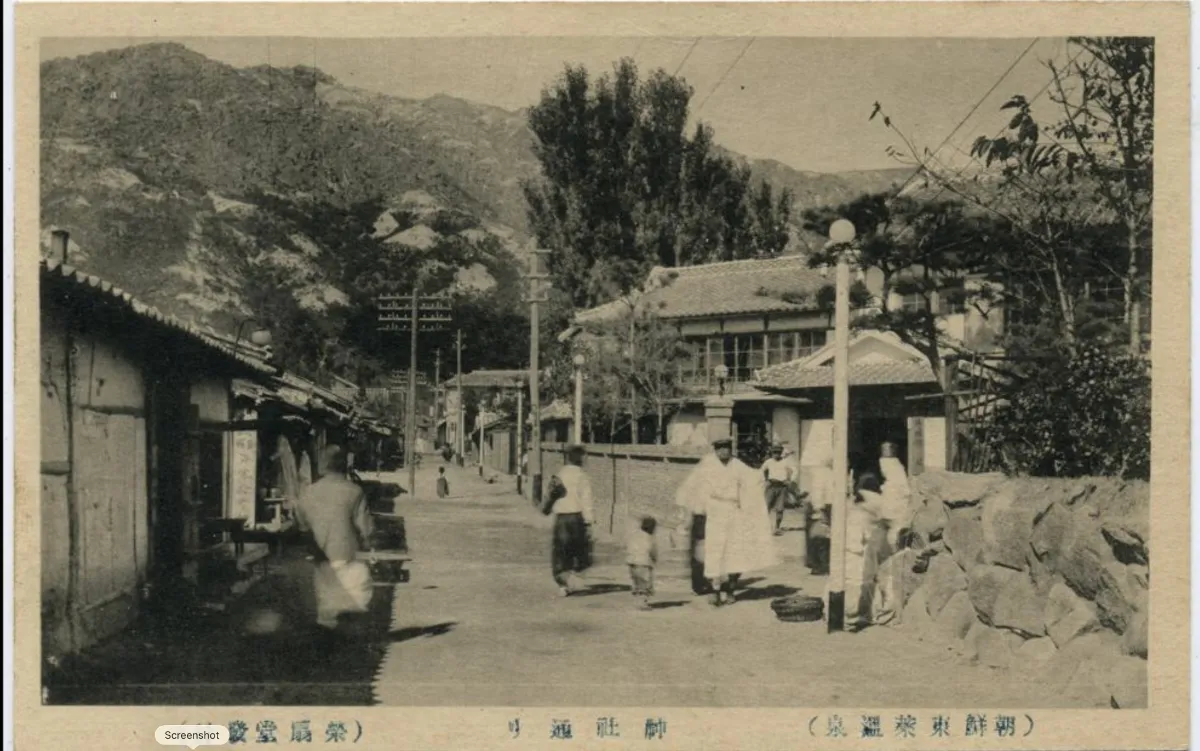
Over the centuries, Oncheonjang developed into a popular place for bathing and relaxation. During the Japanese colonial period, hotels and bathhouses brought more visitors to the area.
Some of that older character is still visible today.
There are traditional bathhouses tucked away in the streets, larger spa complexes and public footbaths where people can sit and enjoy the warm water.
And then there's Heosimcheong, of course, which uses water from its own hot spring source.
Personally, I rather like the mixture of old and new in Oncheonjang. You can walk past modern apartment buildings, turn a corner and find something that reminds you of a very different period in the area's history.
And although the streets and buildings have changed enormously, people still come here for the same reason they did centuries ago.
The hot water.
And now we're officially a Hot Spring City
While reading about all this, I came across another interesting piece of news.
On 1 October 2026, just a few days ago, the Korean government officially designated the Dongnae hot spring district as South Korea's fourth Hot Spring City.
According to the Ministry of the Interior and Safety, the district attracts around two million visitors a year.
Two million! That's quite a lot of people coming here for a bath.
The authorities want to develop the area further, with new wellness facilities and activities connected to the nearby Geumjeongsan mountains. Plans also include a hot spring festival and facilities where visitors can enjoy the natural water.
I suppose that's good news for our neighbourhood.
Although I must admit that I rather like Oncheonjang the way it is now. It still has a slightly old-fashioned atmosphere in places, with small shops and traditional bathhouses alongside modern hotels and apartment buildings.
I hope some of that character will remain.
Busan has it all. Or so it seems.
When people talk about Busan, they usually mention Haeundae Beach, Gwangalli, the seafood markets or the busy harbour.
And rightly so.
But after living here for some time, I've discovered that some of the most interesting things aren't necessarily the famous tourist attractions.
Sometimes they're things you pass almost every day without really noticing them.
A rather ordinary-looking building in our neighbourhood, for example.
Who would have thought that the noise from a large cooling installation could lead me to a story about underground heat, Korean kings, old legends and centuries of bathing?
Well, it did.
And the funny thing is that the explanation was there all along. On a large sign attached to the machine, written in Korean.
I just needed to stop and take a closer look.
Next time I walk past the pumping station, I'll know a little more about what's going on inside and why it matters to Oncheonjang.
And I'm sure there are plenty of other things in our neighbourhood waiting to be discovered.
Busan has it all. Even hot water coming straight out of the ground.
Riemer Kramer — OurBusan.life
Sources for publication
These are the sources I'd place beneath the article, rather than interrupt the story with links.
-
Ministry of the Interior and Safety — Dongnae designated a Hot Spring City (1 October 2026). Confirms the 70.3°C temperature, national ranking, designation, visitor figures and development plans.
-
K-water — Groundwater and hot springs in Busan. Describes the underground heating process, mineral content, extraction depths, Silla historical references and white crane legend.
-
Dongnae District — Onjeong Gaegonbi historical monument. Confirms the 1766 rebuilding of the bathing facilities and the accounts of royal visits.
-
Dongnae District — The white deer legend. Provides the local folklore surrounding the discovery of the springs