
The Day the Heavens Opened
On Korea’s National Foundation Day, an ordinary building in Oncheonjang opens a door to an older Korea: Buddhist symbols, Korean shamanism, Dangun and the meaning behind “the day heaven opened.”
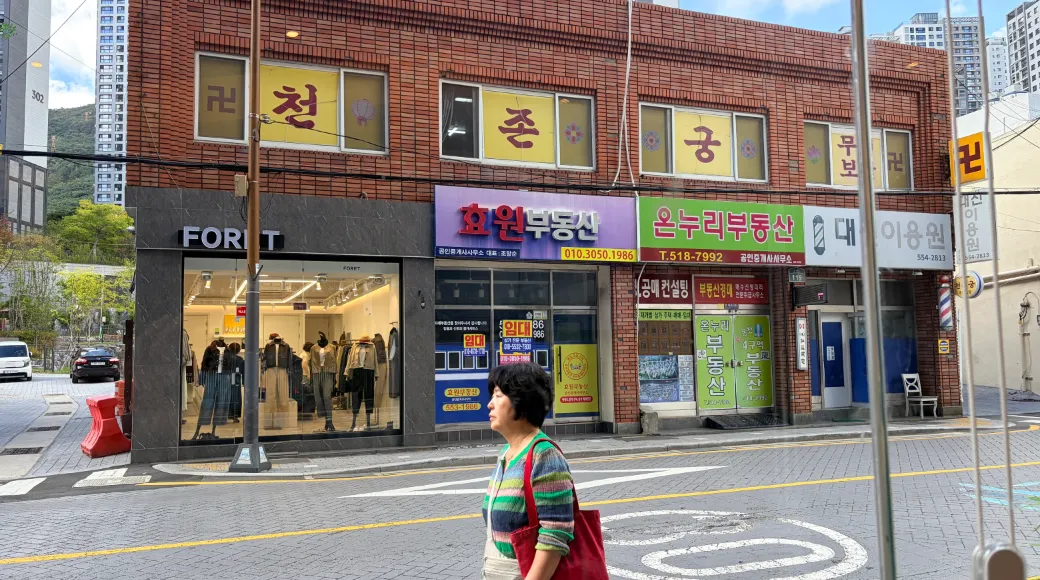
After lunch in Oncheonjang this afternoon, I looked across the street at a building I had probably passed many times before.
Nothing special at first sight. A clothes shop, two real-estate offices, an empty shop and a barber.
Then I noticed the windows upstairs.
Large Korean characters. Yellow panels. And a symbol that, to European eyes, is difficult to ignore.
A swastika.
Or at least, that was my first reaction.
Living in Korea teaches you fairly quickly that this symbol means something completely different here. The 卍, called manja in Korean, has been used in Buddhism for centuries. You see it at temples, on signs and sometimes on maps. Its history in Asia is much older than the symbol used by Nazi Germany.
So I first thought there must be some kind of Buddhist temple or office upstairs.
But the place did not look like a temple at all.
The words on the windows were 천존궁 — Cheonjon-gung. Gung means palace or hall, and cheonjon refers to a heavenly or exalted deity.
That made me look again.
What I seemed to be seeing was not simply a Buddhist place, but something closer to Korean folk religion and shamanism.
And then I remembered the date.
It was October 3.
The day heaven opened
October 3 is Gaecheonjeol — 개천절, Korea’s National Foundation Day.
The name is often translated as “the day heaven opened.”
Most explanations say that the day remembers Dangun, the legendary founder of Gojoseon, traditionally dated to 2333 BC.
But the story starts before Dangun.
According to the old foundation story, Hwanung, the son of the heavenly god Hwanin, came down from heaven to the human world. He settled near Mount Taebaek and began ruling there.
Later, a bear and a tiger came to him because they wanted to become human.
Hwanung gave them garlic and mugwort and told them to stay away from sunlight for a hundred days.
The tiger gave up.
The bear stayed.
She became a woman, Ungnyeo, and later gave birth to Dangun.
Dangun then became the founder of Gojoseon.
It is a myth, of course, not history in the modern sense. The oldest surviving written version appeared much later in the Samguk Yusa.
Still, the story says something about the old religious world of Korea.
Heaven mattered. Mountains mattered. Spirits mattered.
And Dangun himself does not simply disappear at the end of the story. In one version, after ruling for many years, he becomes a mountain god.
That part caught my attention.
Because suddenly the distance between this ancient story and the place above the barber shop did not seem so large anymore.
Korean shamanism
Korean shamanism is usually called musok — 무속.
The best-known figure in this tradition is the mudang, usually translated as shaman.
A mudang may perform rituals called gut. These rituals can involve music, offerings, prayer and contact with gods or spirits.
People may visit a mudang because they are worried about their health, their family, money, work or bad luck. Some rituals are connected with ancestors or with the dead.
For many foreigners, this side of Korea is easy to miss.
Buddhist temples are easy to recognise. Churches are even easier. Their red crosses are visible all over Korean cities.
Shamanism is less obvious.
You do not always find it in a special religious building.
A mudang may work from a small shrine room or practice space inside an ordinary building.
And that was exactly what interested me about the place across the street.
Below it, people were discussing apartments.
Next door, someone was getting a haircut.
Upstairs, behind yellow windows, was a place connected with gods, spirits, fortune and ritual.
No mountain temple.
No gate.
Just another floor in an ordinary building.
So why the Buddhist symbol?
The manja on the windows still confused me.
If this place was connected with shamanism, why was there such a clear Buddhist symbol?
The answer is probably that the borders between Korean Buddhism and folk religion have never been completely fixed.
Over many centuries, Buddhist ideas entered Korean folk religion. At the same time, Buddhist temples sometimes included older local beliefs, especially beliefs connected with mountains and mountain spirits.
That does not mean that Buddhism and shamanism are the same thing.
They are not.
But it does mean that a Buddhist symbol on a window does not necessarily tell you the whole story.
And in this case, I should also be careful.
I was standing across the street.
I could see the signs and symbols.
I could make a reasonable guess about the kind of place it was.
But I do not know exactly what happens behind that door, or who runs it.
To know that, I would have to go upstairs and ask.
I may do that one day.
October 3
What made the whole thing more interesting was the date.
The word Gaecheon refers to the opening of heaven.
Long before October 3 became a modern national holiday, autumn was already an important time for rituals in ancient Korea. After the harvest, people gave thanks to heaven and held ceremonies connected with the gods.
Much later, the Dangun story also became important for Korean national identity, especially during the Japanese colonial period.
After the foundation of the Republic of Korea, October 3 remained a national holiday.
I knew all that only in a very general way.
October 3 was a day off.
Dangun had something to do with it.
That was about as far as my knowledge went.
But this afternoon the words suddenly became more interesting.
Gaecheon. Opening heaven.
On exactly that day, after an ordinary lunch in Oncheonjang, I happened to look up at the first floor of an ordinary building.
There was a barber downstairs.
There were two real-estate offices.
And upstairs was a small part of an older Korea that I had never noticed before.
I had probably walked past it many times.
This time, I looked up.