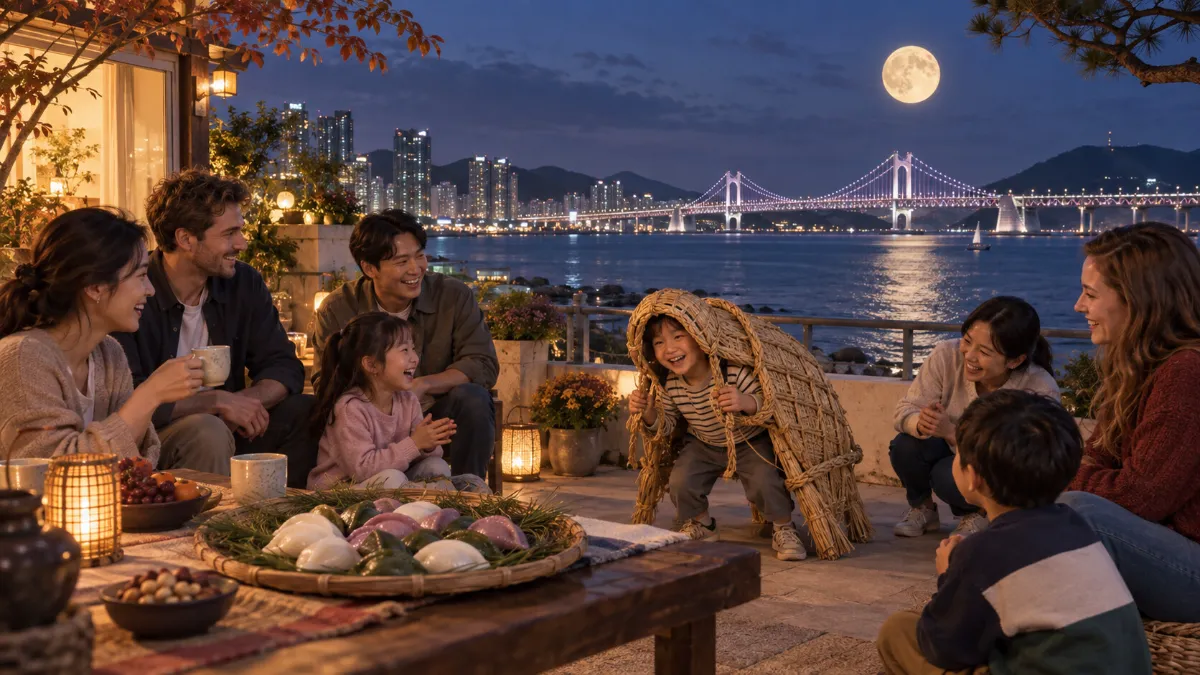
Chuseok Under the Full Moon
Most people living in Korea know roughly what Chuseok is. Families get together and many people visit the graves of their ancestors. Large amounts of food are prepared and, of course, there is songpyeon.
Foreigners are often told that Chuseok is “Korean Thanksgiving”. It is an easy introduction, but it leaves quite a lot unexplained. Since living in Korea, I have gradually discovered how much history and symbolism are behind this familiar holiday.
This year, the main day of Chuseok falls on Friday, September 25. The official holiday runs from Thursday the 24th until Saturday the 26th. With Sunday included, most people who normally work five days a week will have four consecutive days off.
Because the last official holiday falls on a Saturday rather than a Sunday, Monday September 28 is not automatically a substitute holiday. There has been some public discussion about making it a temporary holiday, but at the time of writing that has not been decided.
Pinpointing the origin of Chuseok is more difficult.
A story that is often repeated takes us back to the ancient Silla Kingdom. According to the Samguk Sagi, groups of women took part in a weaving competition that lasted for about a month. On the fifteenth day of the eighth lunar month, their work was compared. The losing side had to provide food and drink, after which everybody celebrated.
It is a good story and it may tell us something about a much older autumn festival. However, it does not prove that Chuseok began with this particular competition. The Samguk Sagi was written centuries after the events it describes. The weaving contest belongs in the history surrounding Chuseok, but calling it the exact beginning goes a little too far.
Chuseok probably developed gradually from customs related to the harvest and the remembrance of ancestors. Its older name, Hangawi, refers to the middle of autumn.
In a farming society, the timing made sense. Much of the hardest work had been done and newly harvested rice and fruit were becoming available. People could share the results of their work and offer some of the first produce to their ancestors. Parts of that tradition remain visible today, although many families have shortened or simplified the ceremonies.
The Curious Shape of Songpyeon
One detail has always puzzled me. Chuseok is celebrated under a full moon, while songpyeon is usually shaped like a half-moon.
There are several explanations. The best-known one says that a full moon has already reached its peak and will start to become smaller. A half-moon can still grow. It therefore came to suggest development and hopes for the future.
It is a lovely explanation, although it belongs to tradition rather than proven history.
Songpyeon was originally made from freshly harvested rice. Fillings could include sesame seeds, beans or chestnuts. The cakes were steamed on pine needles, which stopped them from sticking together and gave them their familiar smell. The Korean word song means pine.
According to another old belief, someone who makes beautifully shaped songpyeon will find an attractive partner or have a beautiful child. I doubt that many Koreans still take this seriously, but it probably helped to keep children working carefully in the kitchen.
Chuseok was once much more of a public celebration than many of us realise. Depending on the region, people took part in wrestling or archery competitions. There was also dancing and, no doubt, plenty to eat and drink.
One of the best-known traditions is ganggangsullae. Women joined hands and danced in a circle under the full moon. The custom was particularly common in the south-west of Korea and is now recognised by UNESCO as Intangible Cultural Heritage.
In parts of central Korea, people performed geobuknori, or turtle play. They made a turtle costume from materials such as sorghum stalks and went from house to house. The performers wished families health and prosperity and received food or drink in return.
That last custom has a curious resemblance to Halloween. People wearing a costume went from door to door and were given something to eat.
An Unexpected Resemblance to Halloween
There is no known historical connection between Chuseok and Halloween. They developed in different places and from different traditions.
Halloween grew out of the Christian observance of All Hallows’ Eve. Older Celtic customs, particularly Samhain, are also often mentioned when its development is discussed. Chuseok grew within Korea’s agricultural and family culture.
The two holidays do share an awareness of the dead, although they treat the subject very differently. Halloween eventually turned ghosts and spirits into something mysterious, frightening and often entertaining. At Chuseok, the dead are remembered as members of the family.
Families may clean graves, bring food and bow to their ancestors. During charye, food is placed on a ceremonial table at home. Many families no longer carry out the complete ceremony, but remembrance continues to play an important part in the holiday.
The turtle players going from door to door provide an amusing echo of trick-or-treating. It remains a coincidence and does not point to a shared origin.
Chuseok in Busan
I looked for an old Chuseok tradition belonging specifically to Busan, but could not find one that was convincing enough to include. Suggesting otherwise would make the Busan connection sound stronger than it really is.
Busan does, however, offer a good view of what the holiday has become.
Before Chuseok, Busan Station and the bus terminals fill with people carrying suitcases and presents. Some leave the city to visit relatives elsewhere. Others travel to Busan because their parents or grandparents live here.
Once the holiday begins, the city feels different. Residential streets can become very quiet. Many local restaurants and smaller shops close, sometimes for several days. The beaches and larger parks may still be busy with families who have finished their visits or have decided to spend part of the holiday outdoors.
For people who do not have a family celebration to attend, there are other ways to experience Chuseok. The Busan National Science Museum, for example, is organising traditional games and family activities from September 24 to 27 this year. Museums and public facilities elsewhere in the city also use the holiday to introduce children to games such as yutnori and jegichagi.
Activities that were once part of village life are now being rediscovered during organised events. Children may first encounter them at a museum rather than through their grandparents.
The family side of Chuseok is changing as well. A nationwide survey conducted before Chuseok in 2025 found that 35 percent of respondents planned to hold an ancestral rite or memorial ceremony. Half intended to visit a grave, clear a burial site or go to a columbarium. Older people were considerably more likely to do this than younger generations. Almost three in ten respondents planned to use the holiday for a trip.
There is also a less cheerful side to Chuseok. Travelling can be exhausting and expensive. Preparing food for a large family takes a great deal of work, which has traditionally fallen mainly to women. Younger relatives may already know which questions about their job, income or marriage plans are waiting for them.
As with most major family holidays, people experience Chuseok differently. It can be warm and enjoyable, but also tiring or occasionally uncomfortable.
Families continue to find their own way of celebrating. Ceremonies are shortened and some customs slowly disappear. Other traditions return as cultural activities at museums and festivals. Chuseok in 2026 is clearly different from the holiday celebrated several generations ago. Even so, it still creates a rare moment when much of Korea pauses and millions of people think about home.
Calling Chuseok “Korean Thanksgiving” may be convenient, but by now we have probably established that quite a lot gets lost in the translation.
Whatever you already know about Chuseok, and however you plan to spend it, I hope you enjoy the holiday. Have some good food, take a break and look up at the full moon if the Busan sky is clear.
And if you make songpyeon, try to make a nice one. You never know.
Happy Chuseok! 즐거운 추석 보내세요!