


Health Insurance in Korea: Where Do You Start?
Health insurance in Korea can be confusing at first. This first article in a 10-part series explains National Health Insurance, Silson and fixed-benefit insurance, and why being insured does not always mean every medical cost is covered.
When my Dutch husband and I moved to Korea after living in the Netherlands for 20 years, health insurance turned out to be one of those subjects that looked simple from a distance. Then we actually had to use it.
My husband wanted to know what National Health Insurance really paid for, why you could still leave a hospital with a bill, and why so many people in Korea also seemed to have private insurance.
I was born in Korea, but after 20 years abroad I also had things to learn. Later, through my work as an insurance adviser, I developed a strong understanding of the Korean insurance system. I am happy to share that knowledge with foreign residents who may find the system difficult to understand.
A useful place to begin is not with company names or insurance products. It is with the bill you receive after visiting a clinic or hospital.
National Health Insurance is the starting point
Korea’s National Health Insurance is the public health insurance system.
If you are insured, that does not mean that every consultation, test or treatment is free. National Health Insurance pays according to the rules of the national scheme, but you may still have to pay part of the cost yourself. Some services are not covered by National Health Insurance at all.
That can be confusing the first time it happens. You visit a clinic, receive treatment and then get a bill. It may feel as if the insurance has not been applied, but that is not necessarily the case. Part of the cost may already have been paid through National Health Insurance, while the remaining amount is your share.
Two Korean words help make sense of this:
급여 (geubyeo)
A service covered by National Health Insurance.
비급여 (bigeubyeo)
A service not covered by National Health Insurance.
You may see both on hospital documents and medical receipts.
There is a small language trap here. 급여 also means “salary” in everyday Korean. On a medical bill, it has a different meaning.
If you are unsure about a treatment, you can ask:
이 진료는 국민건강보험이 적용되나요?
Is this treatment covered by National Health Insurance?
It is a useful sentence to know, especially before a test or treatment that may be expensive.
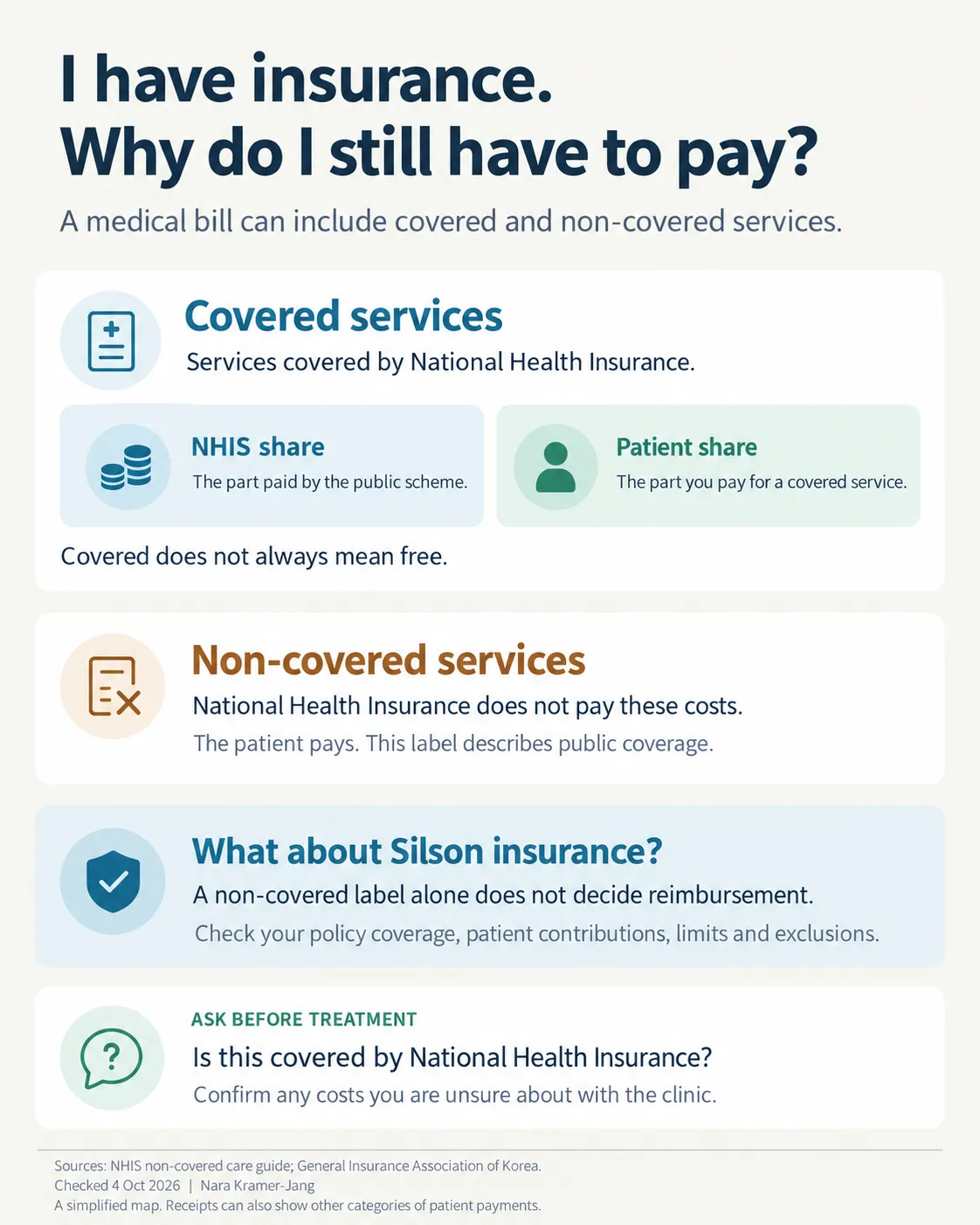
Covered does not mean free
If a service is marked 급여, National Health Insurance applies. That still does not mean that the patient pays nothing. You may have to pay part of the cost yourself.
If a service is marked 비급여, National Health Insurance does not pay for that service.
This is where another misunderstanding often starts. People sometimes assume that if National Health Insurance does not cover something, private insurance will.
That is not how it works.
The label 비급여 only tells you that the national system does not cover that expense. Whether a private insurance policy will reimburse it depends on the policy itself.
Where Silson fits in
One of the most common forms of private health insurance in Korea is Silson insurance (실손보험).
Silson is medical expense insurance. It can reimburse eligible medical expenses that you have actually paid.
The important word here is eligible.
Silson does not automatically return every amount on a hospital receipt. Policies contain limits and exclusions. Patient contributions may apply. The exact conditions can also depend on when the policy was taken out.
So when you see 비급여 on a hospital bill, it is worth checking your Silson policy rather than assuming the expense will be reimbursed.
The company name alone does not tell you enough. What matters is what is written in the contract.
Private insurance can work in another way
Not all private health insurance reimburses medical expenses.
Some policies pay an agreed amount when a specific condition in the contract is met. A policy might, for example, provide a fixed payment for a particular diagnosis or surgery.
That payment is not calculated from the hospital bill. It is based on the conditions written into the policy.
This is different from Silson.
Silson is linked to medical expenses you actually paid. Fixed-benefit insurance is linked to an event or condition described in the contract.
Understanding that difference already makes the Korean insurance system a lot easier to follow.
The cost of illness does not stop at the hospital
When we think about health insurance, hospital costs are usually the first thing that comes to mind.
But illness can affect your finances in other ways too. You may need time away from work. Your income may fall. At the same time, your normal household expenses continue.
That is one reason fixed-benefit insurance exists. A payment after a qualifying diagnosis or surgery is not tied directly to a particular hospital bill and may help with other expenses during a period of treatment or recovery.
That does not mean that everyone needs additional insurance. What is useful depends on what you already have, what your employer provides and how much financial reserve you have.
One word, several kinds of insurance
“Health insurance” sounds like one thing. In Korea, it can refer to very different forms of cover.
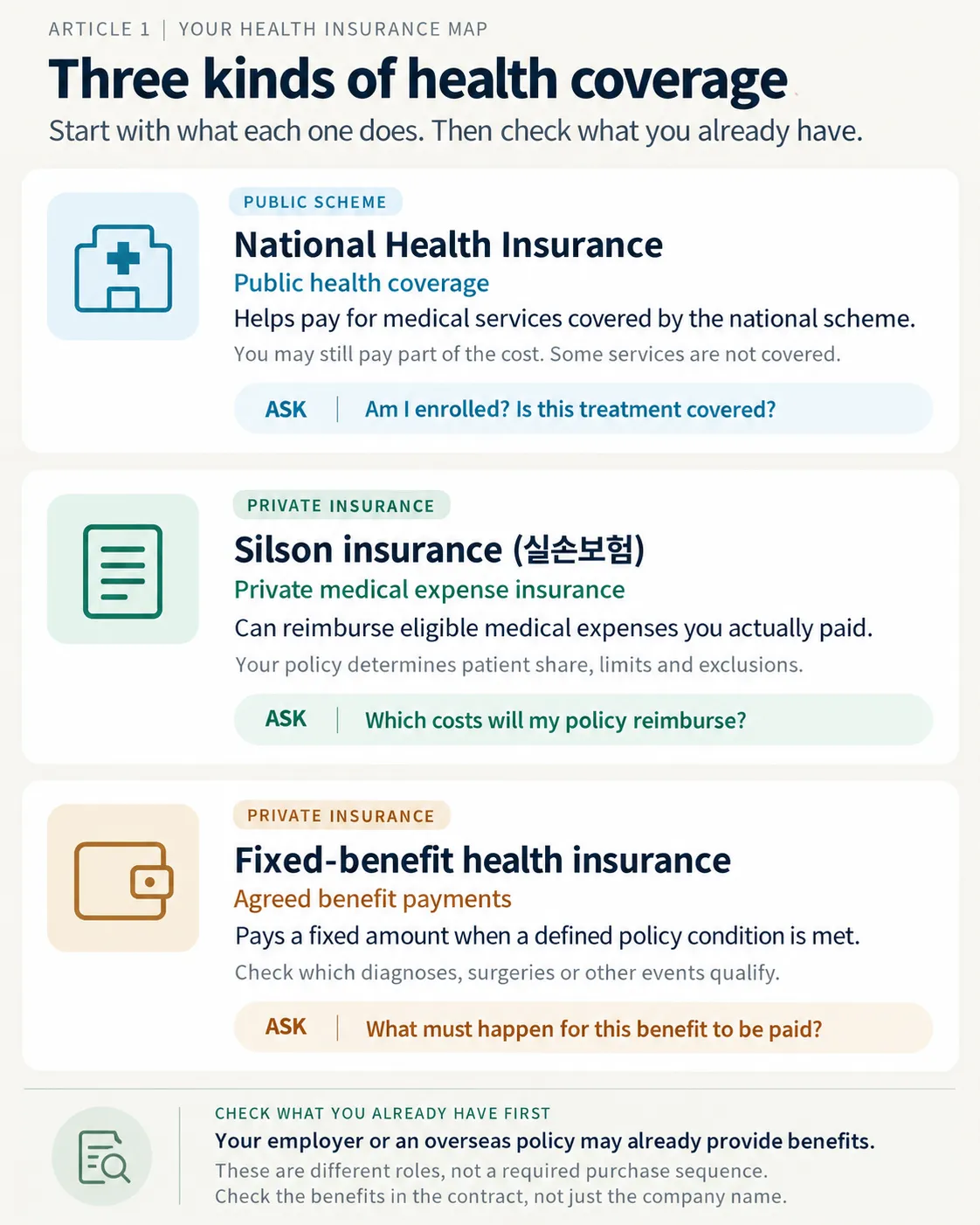
National Health Insurance is the public system.
Silson is private medical expense insurance.
Fixed-benefit health insurance can pay an agreed amount when the conditions in the contract are met.
These types of insurance can exist alongside each other because they do different things.
Having more policies does not automatically mean having better protection. Two policies may overlap, while another important risk remains uncovered.
You may also already have benefits through your employer. Some foreign residents still have insurance from another country, although whether that remains useful in Korea depends on the policy.
Before looking for anything new, it makes sense to find out what is already there.
Life insurance and non-life insurance
Another distinction you will often see in Korea is between life insurance and non-life insurance.
These terms mainly describe the type of insurance company.
Life insurers traditionally provide products connected to life, death and pensions. Non-life insurers cover areas such as property, liability and motor insurance.
Health and accident insurance do not fit neatly into only one of those categories. Both life and non-life insurers can offer health-related products, including some cancer and medical policies.
For most people trying to understand their own cover, the type of company is less important than the policy itself.
What does it pay? When does it pay? What are the conditions?
Those are the questions that matter.
Start with what you already have
If you are living in Korea and are unsure how your health insurance is arranged, you do not need to understand the entire system in one go.
Start with your own documents.
Check whether you are enrolled in National Health Insurance.
See whether your employer provides additional cover.
Look for any Silson policy you may have.
Check whether you have other private health insurance that pays fixed benefits.
If you still have insurance from another country, find out whether it remains valid while you live in Korea.
Once you know what is already in place, the system becomes much easier to understand.
And next time 급여 or 비급여 appears on a hospital receipt, at least those two words will no longer be a mystery.
Sources
Information checked on 4 October 2026.
National Health Insurance Service — covered and non-covered care
National Health Insurance Service — guidance for foreign residents
General Insurance Association of Korea — health and accident insurance
Insurance Business Act and related regulations