


I’m Insured. So Why Is the Hospital Still Taking My Money?
You’ve paid your health insurance premiums, seen the doctor, and now you’re standing at the hospital counter staring at a bill. Wait a minute… weren’t you insured? Welcome to Korean healthcare! Part 3 untangles confusing hospital bills, explains what’s covered (and what isn’t), a
When my husband decided to move to Korea after retiring, health insurance was one of his biggest concerns. Perhaps he was already thinking about the check-ups, treatments and occasional hospital visits that tend to become more relevant as we grow older. Not the most romantic part of planning a new life abroad, but certainly worth thinking about.
I had questions of my own. After twenty years in the Netherlands, I was returning to a country where I knew the language but had to get reacquainted with quite a few things. Korean health insurance was one of them.
So when foreign residents tell me they find Korean hospitals and insurance confusing, I understand. We had our own moments of uncertainty while preparing for our move.
And one question keeps coming up:
“If I pay health insurance premiums every month, why do I still have to pay at the hospital?”
A reasonable question. After all, isn't that what insurance is supposed to be for?
The answer begins with three Korean terms you may find on your hospital receipt: 급여, 비급여 and 본인부담금.
Don't worry. You won't need to pass a Korean vocabulary test before leaving the hospital.
One Korean word, two very different meanings
If you're learning Korean, you may already know 급여 (geupyeo) as the word for salary.
On a hospital receipt, however, it means something entirely different. Here, 급여 refers to medical care covered by National Health Insurance (NHI).
Korean certainly knows how to keep language learners entertained.
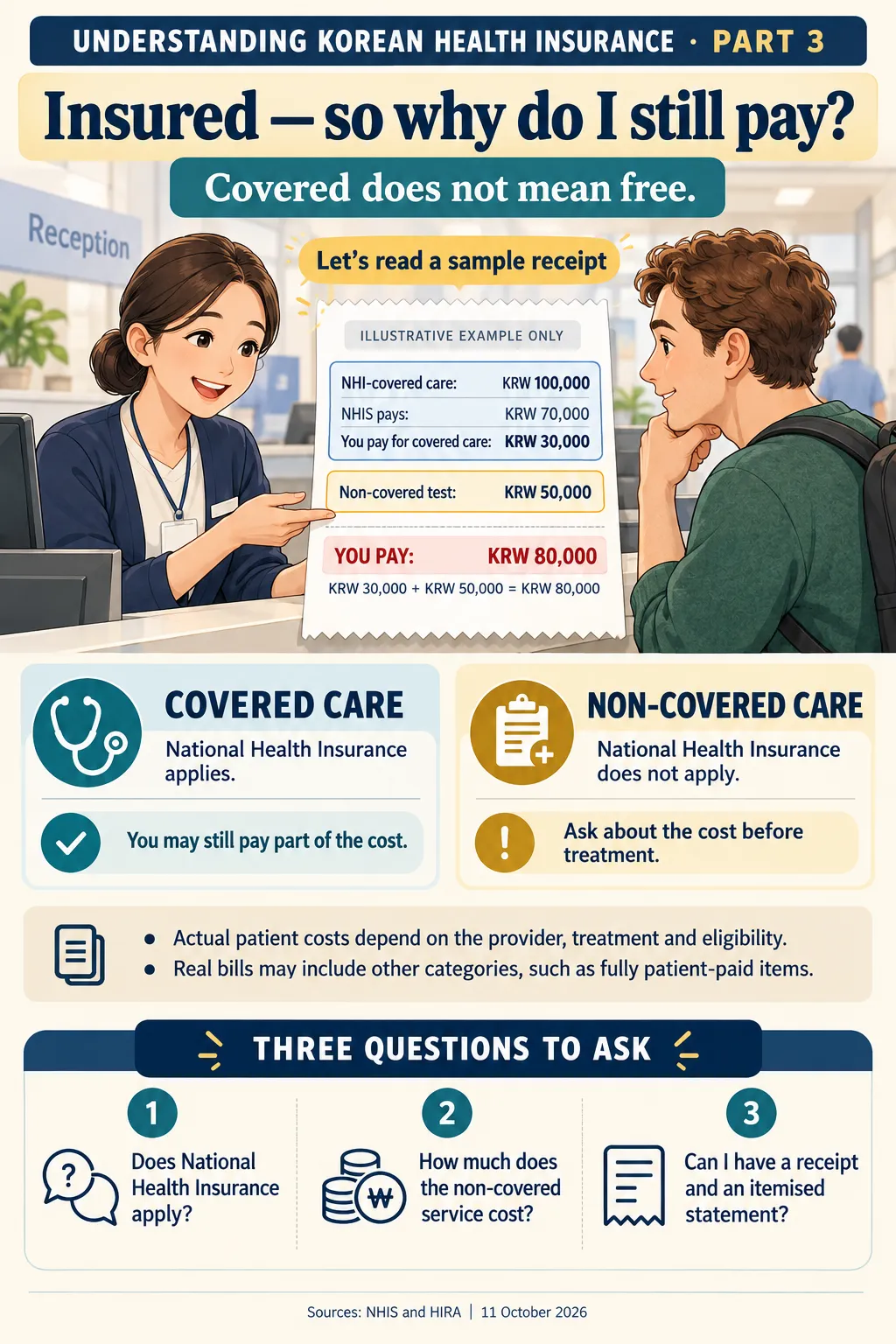
For covered treatment, the cost is generally shared between the National Health Insurance Service (NHIS) and the patient. Having insurance does not mean that every covered service is free.[1]
Let's take Alex, a fictional foreign resident of Busan, as an example.
Alex visits a hospital and receives treatment costing KRW 100,000.
Suppose the cost is divided as follows:
-
NHIS pays KRW 70,000.
-
Alex pays KRW 30,000.
Alex might wonder why he is paying KRW 30,000 when he already pays his monthly insurance premium. What he may not immediately realise is that NHIS has already paid the other KRW 70,000.
These figures are illustrative, not a standard reimbursement rate. What you actually pay depends on several factors, including the type of medical provider, whether you are receiving inpatient or outpatient care, your age and the treatment involved.[1]
The important point is that insurance coverage and full reimbursement are not the same thing.
When the hospital says, “This is not covered”
Now imagine that Alex needs an additional test.
The hospital explains that it is 비급여 (bigeupyeo).
This means the test is not covered by NHI. Alex must pay for it himself.
Unlike covered care, where reimbursement rules determine how costs are shared, prices for non-covered services can differ between medical providers.[2]
That does not automatically mean the test is unnecessary or that the hospital is charging too much. There may be perfectly good medical reasons for recommending it.
But Alex should understand what he is agreeing to.
A useful question would be:
“Could you explain why I need this test and how much it will cost?”
There is nothing impolite about asking.
In fact, even medical tests with the same name may be covered in one situation and not in another, depending on the medical circumstances and applicable insurance criteria.
For some planned services, patients can also check published non-covered service prices through the official information portal.[2]
Understanding the cost before treatment is usually more comfortable than discovering it afterwards.
Particularly when the surprise comes with several zeros.
So how much does Alex actually pay?
Let's return to Alex's hospital visit.
His covered treatment costs KRW 100,000, of which NHIS pays KRW 70,000 and Alex pays KRW 30,000.
Now add a non-covered test costing KRW 50,000.
His payment becomes:
KRW 30,000 + KRW 50,000 = KRW 80,000
Alex is insured. NHIS has contributed KRW 70,000. Yet Alex still leaves the hospital KRW 80,000 poorer.
No wonder he has questions.
The important thing is to understand where the KRW 80,000 comes from. Part is his contribution towards insured treatment. The remainder is for a service that NHI does not cover.
And just when you think you have mastered the system, your receipt may introduce a few additional Korean terms.
For example, 전액본인부담 means that the patient pays the full cost of a service, even though it falls within the covered-care framework. It is a separate category from 비급여.
You may also encounter 선별급여, or selective coverage, where the patient's share can be higher than for ordinary covered treatment.[3]
Fortunately, you don't have to memorise every term.
Two labels are particularly useful:
-
공단부담금: the amount NHIS pays.
-
본인부담금: the amount the patient pays.
If you can recognise those two, you are already better equipped to understand what happened to your money.
And remember that prescribed medication collected from a pharmacy may involve an additional patient payment.[1]
What if you become seriously ill?
This is where understanding the insurance system becomes especially important.
When my husband and I were preparing for our move, we were not only thinking about routine medical appointments. As we get older, the possibility of needing more substantial medical treatment naturally becomes part of the conversation.
A serious illness is worrying enough without having to wonder how the hospital bills will be paid.
Fortunately, Korean National Health Insurance includes arrangements intended to reduce the financial burden in certain circumstances.
One is 산정특례, a special cost-sharing arrangement for people with specified medical conditions, including cancer.
Eligible patients can receive a reduced patient share for qualifying covered treatment. However, this does not mean that all treatment becomes free. Non-covered services remain outside this protection, and eligibility and registration requirements apply.[4]
Another arrangement is 본인부담상한제, the annual ceiling on eligible patient co-payments.
Under this system, eligible NHI patient payments above an individual's annual ceiling are paid by NHIS.
However, the ceiling does not apply to everything. Non-covered services, fully patient-paid items and selective coverage are among the exclusions.[3]
In other words, it is not a maximum limit on your total hospital spending.
If you are dealing with a serious medical condition, I would recommend asking NHIS or your hospital which arrangements may apply to you, including any requirements related to your insurance status as a foreign resident.
A few questions worth asking at the hospital
You do not need to become an insurance expert. But knowing what to ask can make a real difference.
Before receiving treatment, ask:
“Does National Health Insurance cover this treatment?”
If the answer is no, follow up with:
“How much will it cost, and why is it not covered?”
When paying, request both your medical receipt and an itemised statement of the charges. A simple card payment slip will not tell you which treatments were covered and which were not.
If something remains unclear, ask the hospital to explain the charge.
You can also contact the Health Insurance Review and Assessment Service (HIRA) to find out whether its medical expense verification service can examine a charge that you believe may have been incorrectly classified.[5]
This is different from asking whether a private insurance company will reimburse your costs.
One more practical point: if you plan to visit a tertiary general hospital (상급종합병원), check beforehand whether you need a referral document, called 요양급여의뢰서. NHI generally follows a staged referral process, although exceptions exist, including qualifying emergencies.[6]
A little preparation can prevent an unpleasant surprise at the registration desk.
Understanding the bill is the first step
When we moved to Korea, I found that even speaking the language did not automatically make every aspect of the healthcare system easy to understand.
For someone who does not speak Korean, the challenge can be considerably greater.
That is why I believe it is important to ask questions, even when they seem obvious.
You do not have to understand every insurance regulation. But you should know whether a treatment is covered, what you are expected to pay and where you can ask for clarification.
And if you have just paid KRW 80,000 at the hospital despite being insured, you should at least know why.
Of course, that leads us to another question.
“If National Health Insurance doesn't pay everything, can private medical insurance cover the rest?”
Sometimes it can. But that comes with its own rules, exclusions and complications.
In Part 4, we will look at Korean indemnity medical insurance, commonly called 실손보험: what it reimburses, what you still pay yourself and how renewal premiums affect the picture.
Sources and further reading
Source information checked on 21 October 2026. Alex and the amounts used in this article are fictional examples. Actual charges and eligibility should always be confirmed with your medical provider and NHIS. The official sources below provide Korean-language guidance.
[1] NHIS — Scope of benefits and cost sharing
[2] NHIS — Non-covered services information portal
[3] NHIS — Annual ceiling on patient co-payments
[4] NHIS — Special cost-sharing arrangements for specified conditions
[5] HIRA — Medical expense verification service
[6] NHIS — Providers and procedures for insurance benefits
About me
I am Nara Kramer-Jang and I returned to Korea after twenty years in the Netherlands. I am an insurance adviser at Samsung Life's Busan Corporate Branch and I write to help foreign residents better understand Korean insurance. You are always welcome to reach out. I'll be happy to advise.