


I Paid the Hospital. How Much Will I Get Back?
You’ve paid the hospital and submitted your insurance claim. Then the refund arrives—and it’s less than you expected. Part 4 explores what Korea’s silson insurance pays back, what stays out of your pocket, and why next year’s premium deserves a closer look.
There is something reassuring about pressing “submit” on an insurance claim. You have paid the hospital, sent the paperwork and can now look forward to some money coming back.
Then the payment arrives.
You look at the amount. You look at the receipt. You look at the amount again.
“Is that right?”
When I took out private medical insurance after returning to Korea, the possibility of getting hospital expenses back was certainly attractive. I understood that there would be conditions. But, like many people, I was rather more interested in the money coming back than in the small print explaining how much would stay out of my pocket.
In Part 3, we left Alex, our fictional Busan resident, having paid KRW 80,000 at the hospital. National Health Insurance had already contributed towards his treatment, but he still had a bill of his own.
Now suppose Alex also has 실손보험, usually called silson insurance.
Will he get his KRW 80,000 back?
He may get some of it back. How much takes a little more explaining.
The amount you paid is not the amount you are promised
Silson is private insurance that reimburses eligible medical expenses under the terms of your policy. You may also hear people call it 실비보험.
The word “eligible” does quite a lot of work in that sentence.
An insurer does not simply read the total at the bottom of your receipt and transfer the same amount into your account. It checks whether the expenses qualify under your contract and applies the relevant deductions and limits.
Your policy’s own share of eligible costs is called 자기부담금. That amount remains yours to pay. So do expenses outside the policy’s coverage.
This is where expectations can go wrong. You may have bought private insurance precisely because National Health Insurance leaves something for you to pay. Discovering that the private policy leaves something too can feel rather disappointing.
It does not necessarily mean the claim has been calculated incorrectly. But you are entitled to ask how it was calculated.
“But my friend got that treatment reimbursed”
Life abroad would be considerably harder without friends who know how things work.
Unfortunately, insurance is one of those subjects where a perfectly honest account of someone else’s experience can send you in the wrong direction.
Your friend may have an older silson policy. They may have different coverage, or their treatment may have been assessed under different circumstances. The fact that you both call it “silson” does not make the contracts identical.
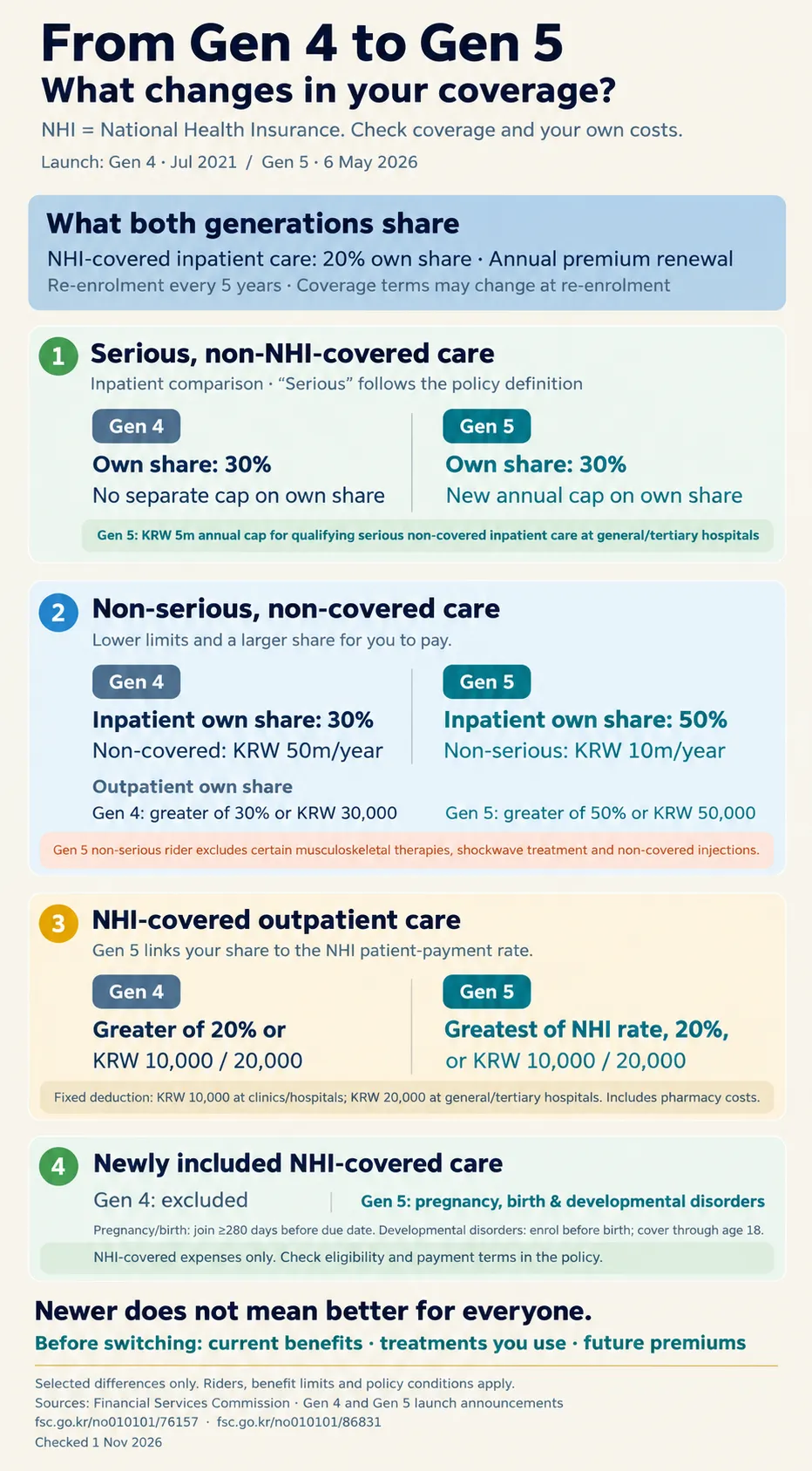
Korea has changed the structure of these policies over time. Fifth-generation silson was introduced in May 2026, with basic coverage for NHI-covered expenses and separate optional additions, called riders, for non-covered care. Different rules apply to serious and non-serious conditions. [1]
Here is a separate example of how that can affect a payment.
For outpatient care under the fifth-generation rider for non-serious, non-covered treatment, the deduction is the greater of 50% of the eligible expense or KRW 50,000. [1]
Suppose an eligible expense under that rider is KRW 100,000. The deduction is KRW 50,000, leaving KRW 50,000 to reimburse, assuming no other restriction applies.
If the eligible expense is KRW 50,000, the deduction leaves nothing to reimburse.
You have insurance. You have a receipt. There may still be no payment for that particular expense.
These figures illustrate one specific part of fifth-generation coverage. They do not calculate Alex’s refund, and they should not be applied to an older policy.
Before planned treatment, it is therefore worth asking your insurer what your own contract would reimburse. Your friend’s experience may start the conversation, but it cannot settle it.
My application involved a look backwards
When I applied for silson, I was thinking about future medical bills.
The insurer was interested in my medical history.
After returning to Korea, I had surgery for a cervical disc problem. That meant providing additional medical records during my application. There was rather more paperwork than I had imagined when first thinking, “It would be good to have insurance.”
Silson does not come automatically with National Health Insurance. It is a separate application, which the insurer assesses before deciding whether to accept you.
For foreign residents, it helps to establish early whether the insurer accepts applications with your residence status and NHI circumstances. Ask which documents it needs before arranging examinations or paying for records. Requirements can differ.
Be accurate when answering questions about previous treatment. And if your application is accepted with an exclusion, make sure you understand what it means. Being accepted is less reassuring if the condition you were worried about is specifically excluded.
A new policy will not reimburse a hospital bill from before its coverage began, either.
Before applying, also check whether you already have silson privately or through work. Several overlapping policies do not each repay the same bill in full. [4]
From hospital receipt to bank account
In Part 3, I suggested keeping your medical receipt and an itemised statement. This is where they become useful.
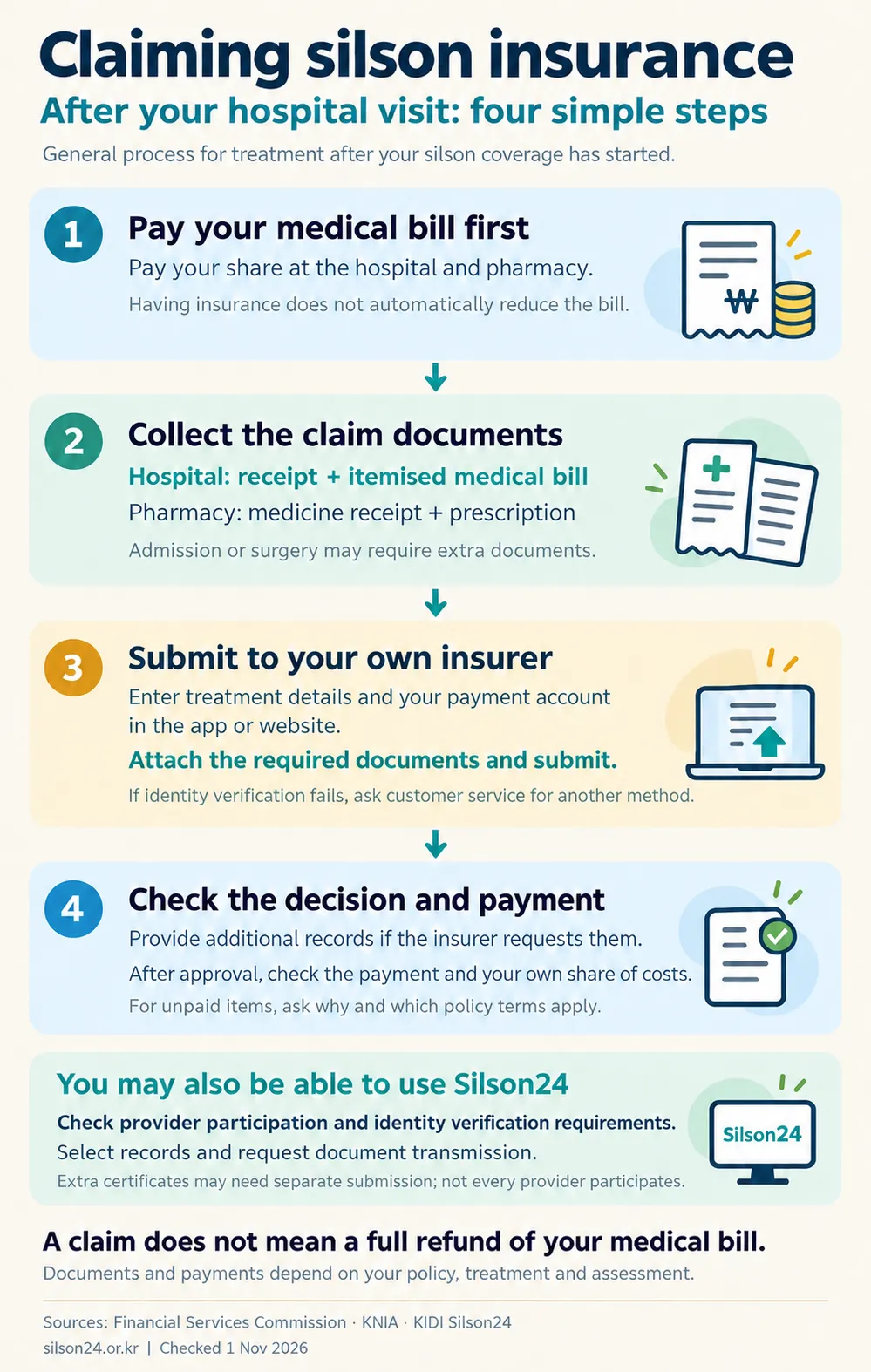
With silson, you generally pay first and claim afterwards. Your insurer’s app or website may let you submit the documents directly. For prescribed medicine, keep the prescription and pharmacy receipt too.
If online identity verification refuses to cooperate, ask the insurer about another submission method. Getting stuck at the login stage does not tell you whether the treatment is covered.
You may also be able to use 실손24, or Silson24. This service lets you request electronic transmission of claim documents from participating hospitals and pharmacies. Check whether your provider is connected; additional certificates may still need to be supplied separately. [3]
One expense you may be able to avoid is paying for unnecessary paperwork. Do not assume every claim needs a medical certificate. Depending on the claim, simpler documents may be sufficient. Ask the insurer before buying extra records. [2]
And when the money arrives, look beyond the bank notification.
If the payment is lower than expected, ask the insurer to explain the deduction and identify any expenses it did not reimburse. If something was excluded, ask which policy provision applies.
You do not have to become an insurance specialist. You should, however, be able to understand what happened to your claim.
The premium continues after the claim
Getting money back is the satisfying part.
The premium leaving your account every month attracts rather less attention—until the amount changes.
Renewal premiums can change as you get older and applicable rates are adjusted. Ask how this works for your contract. Also check when re-enrolment may change the coverage terms, which is a separate issue from the next premium payment.
Fifth-generation silson also links the premium for its non-serious, non-covered rider to benefits paid under that rider. This is separate from general renewal changes: one claim does not automatically increase your whole premium. [1]
For me, the harder question is what happens over the years.
As we get older, we may need more medical care while finding the cost of keeping insurance harder to manage. A premium that seems comfortable today may feel different later.
When I first applied, I mainly thought about what I could get back. Now I would spend more time considering whether I could keep paying for the policy if the premium rose.
I would also remember that reimbursement comes afterwards. The hospital may need to be paid before the insurer has assessed anything.
Silson can provide considerable help with medical expenses. But knowing what your policy actually pays makes it easier to judge that help—and avoids having to inspect the bank notification three times.
In Part 5, we will look at what happens beyond the hospital bill. If illness keeps you away from work, everyday expenses carry on arriving.
Unfortunately, those do not wait for you to recover.
Sources and further reading
The examples are illustrative. Actual eligibility and reimbursement depend on the policy and the circumstances of the claim. The following sources provide Korean-language guidance.
[1] Financial Services Commission — Fifth-generation silson coverage
[2] General Insurance Association of Korea — Medical insurance claim documents
[3] Korea Insurance Development Institute — Silson24
[4] Samsung Fire & Marine — Guidance on actual medical expenses and overlapping coverage
About me
I am Nara Kramer-Jang and returned to Korea after twenty years in the Netherlands. I am the founder of Kramer&Co Consulting and I am an insurance adviser at Samsung Life’s Busan Corporate Branch. I write to help foreign residents understand Korean insurance. You may reach out when you have questions or need advice. I'm happy to help!