

Busan Eomuk: The Fish Cake, Its History and a Recipe
From steaming street stalls to smart gift boxes, eomuk is unmistakably Busan. Discover the story behind this fish cake, why it is also called odeng, and how to turn it into a tasty local noodle lunch.
A Dutchman living in Busan can hardly be surprised that people enjoy eating fish at a market stall. In the Netherlands, we even have a recognised technique for it: hold a herring by the tail, tilt your head back and lower it into your mouth. It is perfectly normal behaviour at home. Explaining it abroad requires a little more effort.
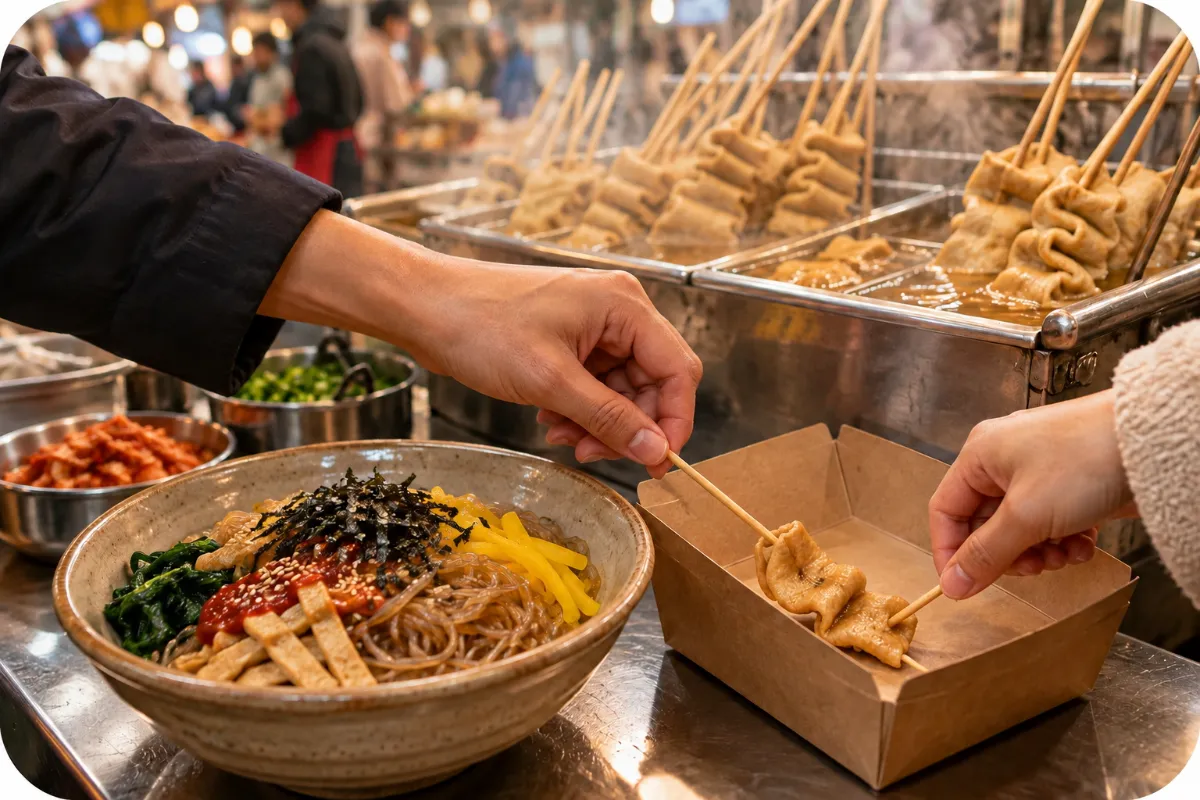
So stopping for a quick fish snack feels familiar. What looks less familiar is a long wooden skewer with something beige folded around it, sitting in a steaming pot.
That is eomuk. It may not win you over on appearance alone, but in Busan it has a reputation that deserves investigating.
What exactly is on that stick?
Eomuk (어묵), usually translated as “fish cake”, is made from finely ground fish mixed with ingredients such as starch or flour, salt and seasonings. The mixture is shaped and cooked, commonly by frying. Thin sheets can then be folded onto skewers and warmed in broth; thicker pieces become snacks in their own right.
“Fish cake” is not the most tempting introduction in English. It sounds vaguely like something you might order by mistake. Good eomuk, however, has a savoury flavour and a pleasantly springy bite. In hot broth it becomes softer and juicy, while freshly fried versions have a firmer outside.
You will also find it in the red sauce of tteokbokki, tucked into gimbap, or sliced and stir-fried as eomuk-bokkeum, a side dish served with rice. Once you start recognising it, you discover that you may already have eaten it several times.
The skewer is an easy introduction. There is often broth to drink as well, which on a chilly day becomes a considerable part of the attraction. Something warm to eat, a hot cup between your hands and a brief pause in your shopping. Nobody expects you to book a table.
Eomuk or odeng?
Just when you have learned the word eomuk, someone calls it odeng. As a beginner in Korean, I would appreciate it if lunch could occasionally settle on one name.
There is an explanation. Eomuk is the Korean name for the fish cake. Odeng (오뎅) comes from the Japanese word oden, although the meanings are not quite the same.
In Japan, oden is a simmered dish that can contain radish, boiled eggs, konjac and several kinds of fish cake. In Korean everyday speech, odeng often refers to the fish cake itself, particularly the familiar version on a skewer.
So you are not necessarily looking at two different foods. A shop may advertise eomuk while its customers call it odeng. Fortunately, pointing at the steaming pot is also fairly effective.
Who invented it?
There is no single person we can confidently thank for inventing eomuk. Fish-paste dishes have a long history in East Asia, and the modern Korean product is closely related to Japanese fish-cake traditions, particularly fried varieties such as satsuma-age.
Japanese production methods became established in Korea during the colonial period, with Busan an important centre. Its port, connections with Japan and access to fish helped the industry develop.
The Korean War brought enormous numbers of refugees to Busan. A rapidly expanded population needed affordable food, and fish-cake production became part of the city’s growing food economy.
One person we can attach to a definite date is Park Jae-deok. In 1953, he founded Samjin in Yeongdo, having learned fish-cake production in Japan. He was an important figure in Busan’s eomuk industry, rather than the inventor of the food itself.
That history gives the modest snack some weight. Its development is connected to colonial rule, war, migration and the work of people building livelihoods in a port city. Today’s neat shop displays give little indication of those difficult beginnings.
How a quick snack became something to take home
Eomuk still belongs to everyday eating, but Busan has also given it a rather smart shop window.
Plain sheets and bars sit alongside versions with vegetables, cheese and other fillings. Specialist shops display them in rows that resemble a bakery counter. Samjin introduced its eomuk-bakery concept in 2013, helping to change how this familiar food was presented.
You can see the practical consequence. You go in for one piece, notice something else, decide that a small assortment would be sensible and leave carrying a box. You tell yourself you will share it when you get home. The challenge is getting it home.
The packaging makes eomuk easy to take home or give as a present. An inexpensive everyday food has become something visitors associate specifically with Busan.
That is where the Dutch herring comparison works for me. The taste and preparation are completely different, but both foods carry a sense of place. Residents know them without explanation; visitors are encouraged to have a go.
And before a Dutch person raises an eyebrow at a folded fish cake, we should remember the herring-by-the-tail business. We are hardly in a position to judge.
And is it healthy?
It contains fish, but that is not quite the end of the discussion.
Eomuk is a prepared product. The proportion of fish varies, as do the amounts of flour, starch, oil and seasonings. Many varieties are fried before they reach the soup pot. A swim in broth does not turn them back into a fish fillet.
When buying it, compare the fish percentage and salt content on the label. Broth and dipping sauces matter too.
There is no need to conduct a full nutritional investigation while everyone behind you waits for a skewer. Just treat eomuk as a food whose ingredients are worth checking, rather than assuming that anything involving fish must automatically be healthy.
From the market to your kitchen
Assuming some of that box makes it home, you have the beginnings of another meal. Eomuk is convenient to cook with: slice it, heat it and add it to something you already enjoy.
But rather than suggest just any noodle dish, I would keep us in Busan a little longer.
Around the city’s old market districts, including Bupyeong Kkangtong Market, you will find bibim-dangmyeon (비빔당면). It combines sweet-potato glass noodles with strips of eomuk, vegetables and a spicy sauce. The fish cake that was the whole snack a few paragraphs ago now shares a bowl with crunchy pickled radish and slippery noodles.
It is a good companion to this story because it shows another side of eomuk: an everyday ingredient that helps turn a few simple things into lunch. You can appreciate the smart gift boxes and still use an ordinary packet of flat fish cakes from the supermarket.
The following is a straightforward home version, not an attempt to reproduce the secret recipe of a particular market stall. You will need about twenty minutes and, ideally, someone else to wash up.
Easy Busan bibim-dangmyeon
Two servings · About 20 minutes
Ingredients
-
150 g dried Korean sweet-potato glass noodles (dangmyeon)
-
100 g flat eomuk, cut into strips
-
100 g spinach
-
50 g yellow pickled radish (danmuji), cut into thin strips
-
A little cooking oil
-
Roasted seaweed strips and sesame seeds, to finish
For the sauce
-
1 tablespoon gochujang
-
1 tablespoon soy sauce
-
1 teaspoon rice vinegar
-
1 teaspoon sugar
-
1 teaspoon sesame oil
-
½ teaspoon finely chopped garlic
-
1–2 tablespoons water
-
Optional: ½ teaspoon gochugaru for extra heat
Method
-
Mix the sauce ingredients. Taste before adding the optional chilli flakes. You can always add more; negotiating with them afterwards is harder.
-
Blanch the spinach for about 30 seconds, rinse under cold water and squeeze dry.
-
Cook the noodles according to the packet instructions. Rinse briefly and drain well. Cut once or twice with kitchen scissors if they are very long.
-
Warm the eomuk strips in a lightly oiled pan until hot throughout, following any cooking instructions on the packet.
-
Divide the noodles between two bowls. Add the spinach, eomuk and radish. Spoon over some sauce, scatter with seaweed and sesame seeds, and mix. Add more sauce to taste.
Recipes vary; this is a simplified home adaptation. Check ingredient and allergen labels: eomuk can contain shellfish as well as fish.
Sit down while the noodles are good
Mix everything thoroughly and eat straight away. The sesame oil brings its nutty aroma, the radish adds a sharp little crunch, and the sauce clings to the noodles. Between them are the soft, savoury strips of eomuk—the same unassuming fish cake that started this whole investigation.
It is a colourful, satisfying lunch without much fuss. The main complication may be persuading the noodles to travel neatly from bowl to mouth. A fork is allowed. This is lunch, not an entrance examination.
And when you next pass a steaming pot at a Busan market, perhaps you will look at its contents with a little more curiosity. You might try a different shape, recognise the name above the counter or buy a few sheets to cook with later. Knowing the history does not change the flavour, but it gives you something to think about while the broth cools.
I still think the Dutch have a perfectly reasonable way of eating herring. But Busan makes a convincing case for putting your fish on a stick—or into a bowl of noodles.
There is room for both. Preferably not in the same bowl.
Sources and recipe inspiration
Frequently asked questions
What is Busan eomuk?
Eomuk (어묵) is Korean fish cake: finely ground fish mixed with starch or flour, salt and seasonings, shaped and usually fried. Busan became the centre of the industry through its port, its links with Japan and the refugees who arrived during the Korean War. Samjin, founded in Yeongdo in 1953, is the best-known Busan producer.
Is eomuk the same as odeng?
In everyday Korean, yes. Eomuk is the Korean word for fish cake. Odeng (오뎅) comes from the Japanese oden, a simmered dish that can include radish, eggs and fish cake, but in Korea odeng usually means the fish cake itself, especially the version on a skewer in broth.
Is eomuk healthy?
It contains fish, but it is a prepared product. The fish percentage varies, as do the flour, starch, oil and salt, and many varieties are fried before they reach the broth. Compare the fish percentage and salt content on the label, and check for shellfish if you have an allergy.