
108 Steps: Visiting Haedong Yonggungsa
Haedong Yonggungsa is Busan’s most photographed temple, and there’s a right time to go. Get it wrong and you’ll queue for every photo. Get it right and you’ll have the waves, the incense and the 108 steps almost to yourself.
Travel & Exploration · Guide
The first thing you notice at Haedong Yonggungsa is the parking lot. It's busy, cars are circling for a space, and there are crowds of people all heading in the same direction. What you can't see from up there is the temple. No roof, no sea view, nothing to suggest that one of the most photographed places in Busan is a few minutes' walk away.
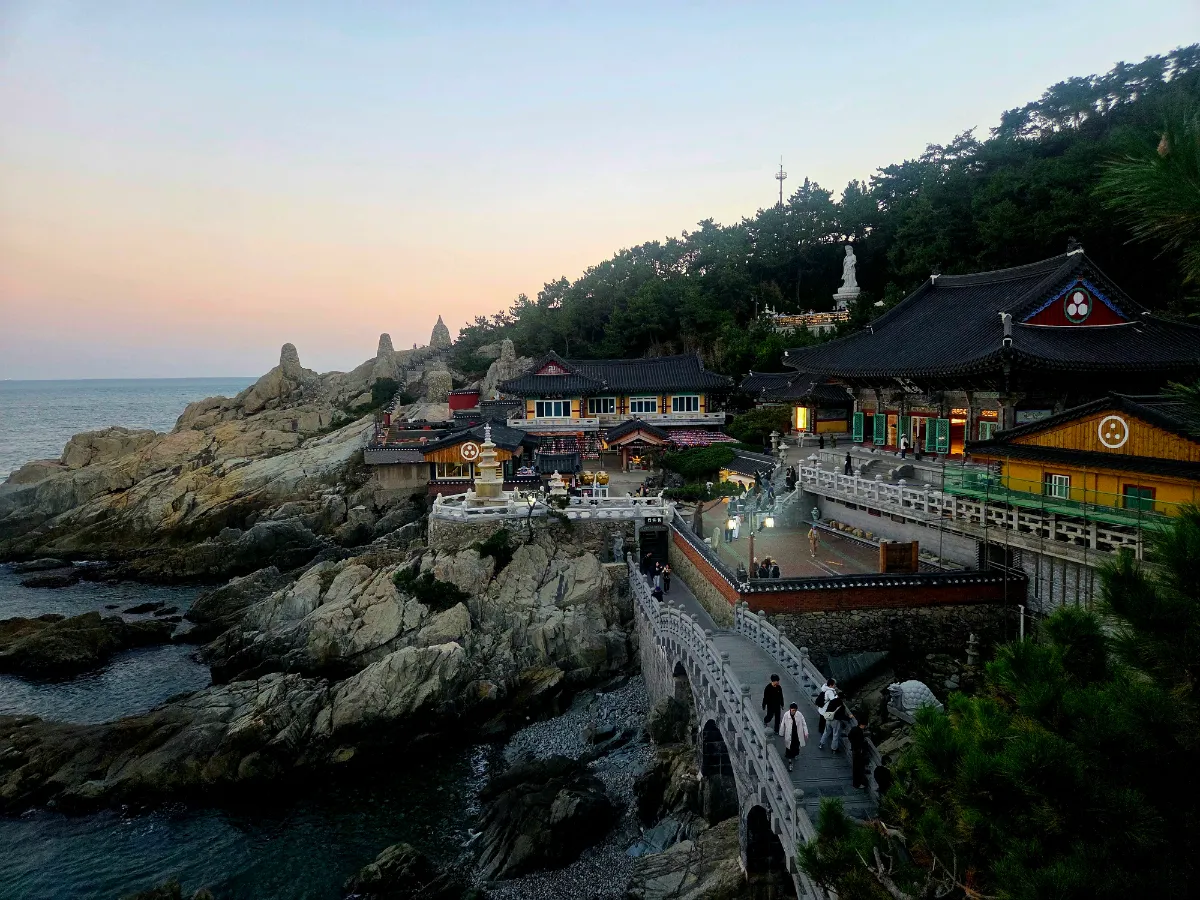
Few things can prepare you for the way the temple is slowly revealed once you start making your way down the stairs. It's built on a rocky ledge in Gijang on Busan's northeast coast, with the East Sea breaking against the rocks a few metres from the halls. After the parking lot, it feels like walking into a different place.
Dragon palace on the rocks
The main courtyard opens straight onto the water. On a windy day the spray reaches the railing, so keep a good grip on your phone near the edge.
The name means roughly "Dragon Palace Temple of the East Sea." The temple is dedicated to Gwaneum, the Bodhisattva of Compassion, whose large statue looks out over the water.
The 108 steps
The main temple is at the bottom of 108 stone steps. In Buddhism, 108 is the number of earthly desires and delusions, and walking the steps is meant as a small exercise in letting them go.
Stone lanterns line the way, and about halfway down there's a viewpoint where people stop to look at the waves. On the way back up, it's also where most people stop to catch their breath, which is the part the brochures leave out.
Statues, shrines and a car tire
Before you reach the stairs, there's a seven-story pagoda with a car tire at its base. People pray there for traffic safety and to avoid accidents. As a frequent commuter on two and four wheels in this city, I can always use some good luck to aid my safe arrivals.
Nearby are twelve stone statues of the Chinese zodiac animals, each about two metres tall. Visitors look for their own birth year animal and take a photo with it, so expect a short queue at the popular ones.
Several statues around the complex have shiny and darkened noses and bellies from years of people rubbing them for luck. One of them is the moon horse, whose nose and belly people stroke because of a story that it brings good luck. Down in the main area, keep an eye out for the golden pig statues, which sit with the cave shrine of the Medicine Buddha. In Korean culture pigs are strongly associated with money and good fortune, to the point that dreaming about a pig is considered a sign to go buy a lottery ticket.
At the bottom of the stairs, a small stone bridge crosses to the main area. People toss coins into the stone bowls below and make a wish.
On the far side is the Daeungjeon Main Hall, built in 1970, with a three-story stone pagoda in front facing the sea. Around it you'll find a cave shrine with a Medicine Buddha, a shrine to the Dragon King, a golden Maitreya Buddha, and five small Buddhas where students and parents pray for exam success. The Gwaneum statue stands above all of it, facing the water.
Six hundred years, give or take
According to the temple, a monk named Naong founded it in 1376 during the Goryeo Dynasty, though some historians doubt that date. The original buildings were burned during the Japanese invasions of the 1590s. Most of what stands today dates from a rebuild in the 1970s, when the monk Jeong-am gave the temple its current name.
If you search for the temple on a Korean map app, the pin shows a 卍 symbol. In Korea that's the standard marker for a Buddhist temple, and it has been used that way for well over a thousand years.
Timing, money and shoes
The gates open around 4:30 a.m. Because the temple faces east, sunrise is the best time to visit, and on New Year's Day it fills up with people coming to watch the first sunrise of the year.
Weekend afternoons are the most crowded. The stairs are narrow, and on busy days it can take a while to get a clear photo.
Entry is free. Parking costs a little, and there are snack stalls along the path from the entrance.
Wear proper shoes, because the steps and uneven rock are hard going in sandals. It's an active place of worship, so dress modestly and keep your voice down near the halls.
Bus, subway or taxi
A taxi from Haeundae Beach takes about 20 minutes and is the easiest option. By public transport, take the Donghae Line to Osiria Station, leave by Exit 1, and catch bus 139 or 1001 for a few stops. From Haeundae Station (Line 2, Exit 7), buses 1001, 181 and 100 take around half an hour.
Get off at the stop named for the temple and the National Institute of Fisheries Science. From there it's a 10 to 15 minute walk to the entrance.
Accessibility and the 108 steps
This is one of the harder major sights in Busan to visit with limited mobility. The main halls are at the bottom of the 108 steps, and the rest of the complex is connected by bridges, narrow paths, uneven rock and more stairs, some of them fairly steep.
Wheelchair users can reach some of the upper areas, including the zodiac statues and the traffic safety pagoda, but the main halls aren't realistically reachable without help. Strollers are difficult on the stairs and slopes, so a baby carrier is the better choice.
If stairs are hard for you, take a taxi to the entrance to skip the walk from the bus stop, go down slowly, and use the halfway viewpoint as a rest stop. Children enjoy the zodiac statues, but keep hold of small hands on the stairs. A weekday morning, with fewer people on the steps, makes all of this easier.
How much time you need
The temple itself takes 1 to 2 hours, including the steps in both directions, the halls, the statues and time for photos. Add your travel time, plus a buffer on weekends when the stairs move slowly.
If you combine it with a couple of the places below, plan for half a day. Add the theme park or the outlets and it becomes a full day.
Around the temple
Gijang has plenty more within a few kilometres, so you don't have to head straight back to Haeundae.
• Sirangdae and the nearby sunrise viewpoints are a short walk along the rocks, with similar views and far fewer people.
• The Osiria Coastal Walk is a 2.1 km seaside trail in front of Ananti Cove.
• Ananti Cove is a resort area further down the coast with cafes, restaurants and shops.
• Lotte World Adventure Busan and Skyline Luge Busan sit next to each other near Osiria Station.
• The Busan National Science Museum is close by and a good option on a rainy day or with kids.
• Lotte Premium Outlets Dongbusan is in the same area if you want to shop.
• Songjeong Beach is quieter than Haeundae, popular with surfers, and on the bus route back into town.
Go at sunrise
If you only take one tip from this post, get there for sunrise. The tour groups usually show up later in the morning, and for an hour or so you get the waves, the incense and the 108 steps without queuing behind anyone for a photo with the zodiac. Afterwards, there are Coffee shops just up the road.