
Coffee, Coffee Everywhere… But Who Drinks It All?
With more than 9,000 coffee shops in Busan, I sometimes wonder who drinks all that coffee. Why do people keep opening new shops when so many others close? Why are coffee chains suddenly selling tteokbokki? And how many cups of coffee do you actually need to sell to make a living?
Food & Drink · Feature / Story
9,182 coffee shops, a cup every 4.3 minutes and the curious coffee culture of Busan.
One of the things that continues to amaze me about living in Busan is the incredible number of coffee shops. How on earth do they all survive? I became curious and, of course, had ChatGPT do some research for me. :)
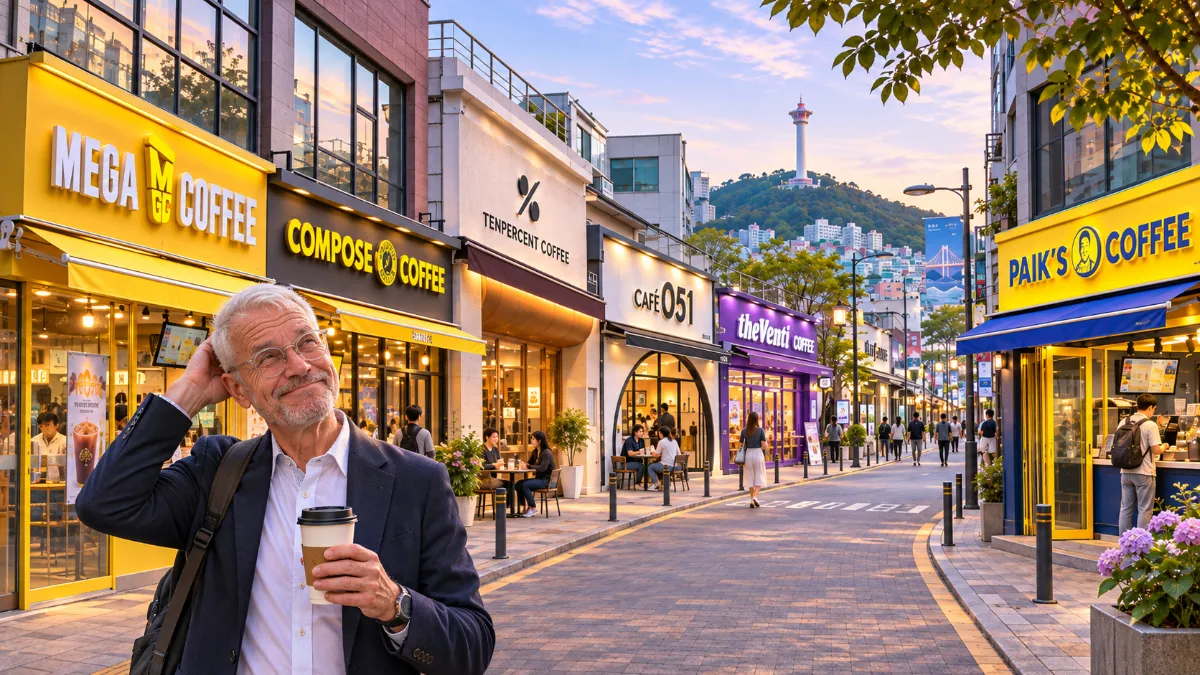
During a normal walk through my neighbourhood in Oncheonjang, I pass TENPERCENT, Café 051, Mega Coffee, Basta Coffee and several independent coffee shops.
And just when I think we really have enough coffee shops, someone starts renovating another empty shop. A few weeks later, there is another espresso machine.
I sometimes wonder whether there are more people in Busan who want to sell coffee than people who want to drink it.
Four close, four open
In 2015, Busan had 3,071 coffee shops. In 2024, there were 9,182. Almost three times as many in less than ten years.
That's one coffee shop for approximately every 360 residents. Including babies, tea drinkers and people who simply don't like coffee.
Interestingly, Spain has a similar number of bars and cafeterias per resident. But there you often go to a bar for coffee. In the Netherlands, we drink coffee practically everywhere.
A Dutch bakery may start selling coffee to make some extra money, while a Korean coffee shop starts selling bread and cakes for exactly the same reason.
Same products, different starting point.
But here comes the strange part. In 2024, 1,375 coffee shops opened in Busan, while 1,470 closed. Less than half of all new coffee businesses survive their first three years.
So every day, roughly four coffee shops closed, while almost four other people thought opening a coffee shop was a good idea.
I wonder whether they had seen these figures.
Why do Koreans drink so much coffee?
According to market research, the average South Korean consumed 405 cups of coffee in 2023, compared with a worldwide average of 152.
Coffee before work, coffee after lunch, coffee during a meeting, coffee while studying and, apparently, coffee when there is absolutely no reason to drink coffee.
Even on freezing winter days, people walk around with enormous cups of iced Americano. There is actually a Korean expression for this: 얼죽아 (eoljuk-a). Even if I freeze to death, I will still drink an iced Americano.
I also came across an interesting UNESCO article: A Little Luxury Meets Big Success in the Republic of Korea.
You may not have enough money to buy an expensive car or a designer handbag, but you can buy a nice drink in a trendy coffee shop. A little luxury for a few thousand won.
New things become popular very fast in Korea. A new drink, a new dessert, a new restaurant. Suddenly everybody seems to know about it and wants to try it and, of course, take a picture of it. ;)
I sometimes wonder what is more important: drinking it or being able to say that you have tried it.
Would you like some coffee with your dinner?
Have you noticed how big the menus in Korean coffee shops are getting?
Sometimes I need several minutes just to find the coffee on the menu of a coffee shop.
Lattes, macchiatos, smoothies, fruit teas, yoghurt drinks, milkshakes, lemonades, cakes, sandwiches and quite a few things I don't recognise.
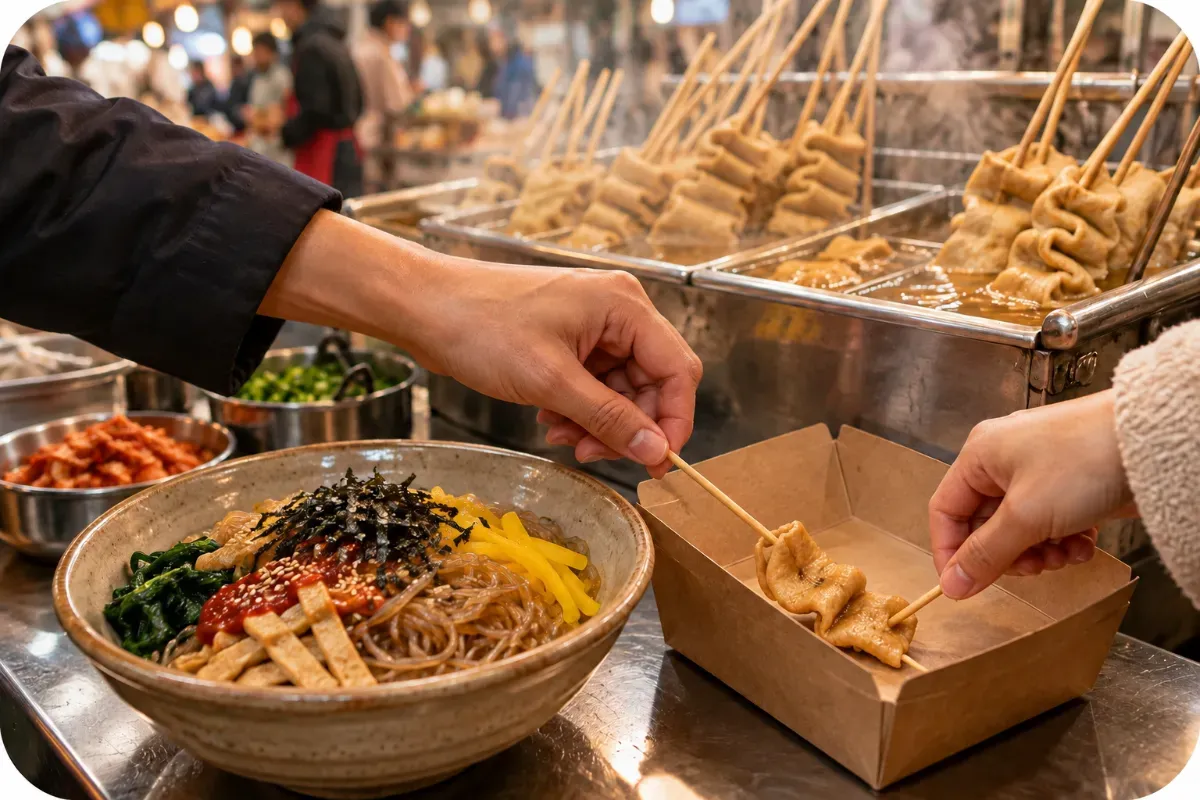
And now there is tteokbokki!
Several Korean coffee chains have even started selling spicy rice cakes and chicken.
Apparently, selling coffee is no longer enough to survive as a coffee shop in Korea. Perhaps one day I will walk into Mega Coffee for dinner and be asked whether I would like a coffee with it.
But it makes sense. If everybody around you sells cheap Americanos, you need to find other ways to make money.
Perhaps those enormous menus are simply a sign of how difficult it has become to make money selling coffee.
A cup of coffee every 4.3 minutes
How many cups of coffee do you actually need to sell every day to make a living?
Let's open my imaginary coffee shop in Busan. I assume my monthly fixed costs are four million won. I would also like to earn 2.5 million won myself.
Let's assume that 65% of my sales is left after paying for ingredients, cups and other direct product costs.
I would need approximately 167 customers a day if everybody orders a ₩2,000 coffee.
Opening twelve hours a day, thirty days a month, that means selling a cup of coffee every 4.3 minutes.
Including Monday mornings, when it rains and when the coffee shop next door has a special promotion.
And preferably without taking a holiday.
If my customers spend an average of ₩3,500 instead, I need around 96 customers a day.
I am beginning to understand why the owner would prefer me to order a caramel macchiato and a piece of cake.
And now the really depressing bit
According to official statistics, about half of Busan's coffee businesses have an annual turnover of less than 63 million won.
That's just ₩5.25 million per month.
Turnover, mind you. NOT income.
The rent needs to be paid, the electricity bill arrives every month, the coffee machine occasionally breaks down and the owner needs to eat something other than the unsold muffins.
I wonder how many coffee shop owners are actually making money and how many have simply spent their savings buying themselves a job.
Time for another coffee
Interestingly, Compose Coffee, Café 051, The Venti and TENPERCENT all started in Busan. We are not only good at drinking coffee here. We are also very good at finding new ways of selling it.
I can understand the attraction of having your own coffee shop. A nice interior, some music, the smell of fresh coffee and friendly customers.
And everybody probably thinks their coffee shop will be a little better, a little different or in a better location.
Unfortunately, thousands of other people have had exactly the same idea.
Somewhere in my neighbourhood, somebody is probably ordering an espresso machine and putting together a menu with forty different drinks.
I wish them well.
Meanwhile, I think I'll have another coffee.
Not because I particularly need one, but because, after looking at the figures, I feel that the owner probably needs me more than I need the coffee.
Sources and further reading
-
Dongnam Regional Data Office – Statistical analysis of coffee shops in Busan, July 2026
-
UNESCO – A Little Luxury Meets Big Success in the Republic of Korea
-
Standing Out and Fitting In: Korean Coffee Entrepreneurs’ Strategies for Survival
-
The Korea Times – Why Is Compose Coffee Adding Tteokbokki to Its Menu?